
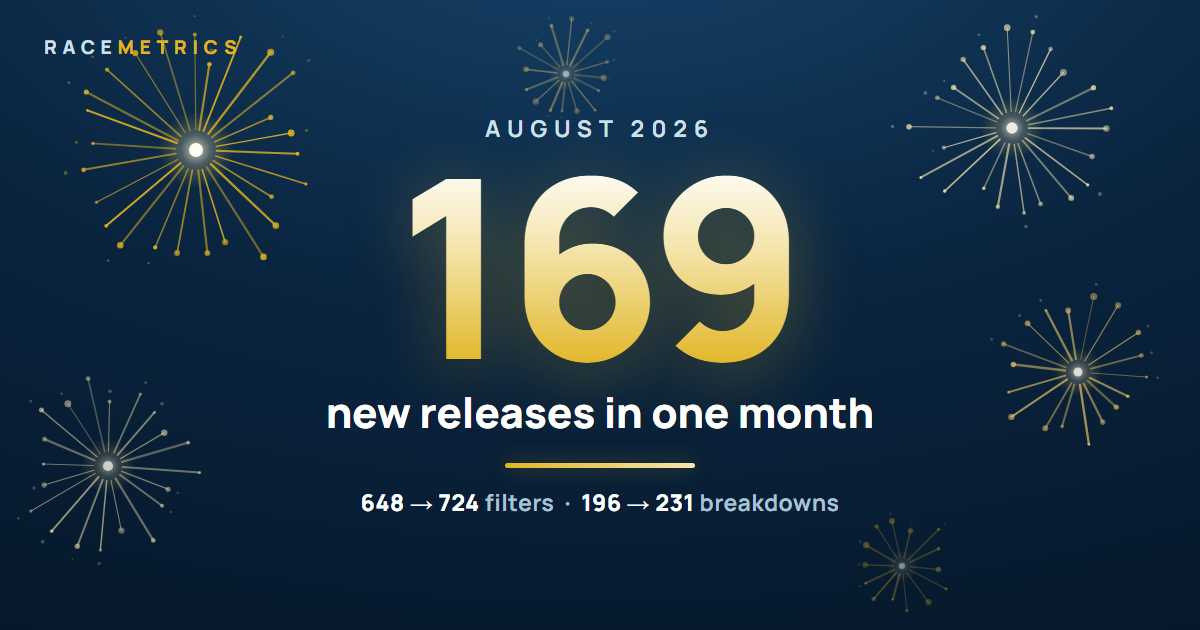
August was bigger than July, and July was the busiest month in RaceMetrics' history. One hundred and sixty-nine separate releases went live — one hundred and fifty-eight in August, and eleven more before lunch on the first of September.
Two of them were not features at all. They were new tools in their own right: My Ratings, which lets you build your own handicap ratings and then does the arithmetic for you, and RMP, a fair price on every runner struck before the market moves.
Here is the whole month in one place.
The month in three numbers
- System Builder filters: 648 → 724
- Breakdown dimensions: 196 → 231
- Releases: 169
My Ratings — your own handicap figures, worked out for you
Plenty of members already keep their own ratings. Almost all of them keep them in a spreadsheet, and the spreadsheet cannot tell you whether they work.
My Ratings arrived on 9 August. You describe the scale you want — what a length is worth, how you treat weight, which speed figure you start from — and it produces a rating for every runner in Britain and Ireland, on your scale, every day. The launch post explains the idea.
Then it grew, most of it in response to members using it:
- A full scale designer, so you are not stuck with our presets — and figures anchored to class and calibrated to the official mark, so a 90 on your scale means something
- Official weight-for-age built in: the BHA flat scale, then the Anglo-Irish jumps scale for chases, hurdles and bumpers
- A weight-adjusted speed figure mode, and a switch to turn the weight adjustment off entirely if you would rather rate the horse than the handicap
- Several scales side by side as separate columns — on the racecard, on At-a-Glance and on My Card — so you can watch two ideas disagree
- Back-testing in the System Builder. This is the part that matters. Your ratings become filters like any other, so "my top-rated in handicap chases" is a system you can prove or disprove over eight years
- Your top-rated ranked before the race over the whole field, non-finishers included, so the back-test matches what you could actually have backed
- Qualifiers, alerts, breakdowns, a Scorecard, notes and CSV export — and a Review Winners view for going back over what you got right and wrong
Two additions late in the month changed who it is for.
Import your own ratings. If your figures already exist in a spreadsheet, upload the file. They then behave exactly like ratings we calculated: a column on every racecard, on My Card, and a filter in the System Builder. Watch how importing works.
Rate the winner, we rate the rest. The fastest way anyone actually rates a race: give the winner a figure, and every other horse is derived from it down your own scale using the official beaten distances. One number per race instead of twelve. Watch winner-anchored ratings.
RMP — a fair price on every runner
On 24 August we released RMP, the RaceMetrics Model Price, to RaceMetrics Pro and Proform Premium members.
Every morning, before racing, every runner gets a price and a one-line RMP View comment. The price is struck once and frozen, so what you see is genuinely what the model thought before the market moved — not a figure quietly rewritten afterwards to look clever. It appears on the racecard, on My Card, on the A-Z, on form lines, on horse profiles, in your qualifiers, in your CSV exports and in the morning email, and it is a filter in both the System Builder and Ask RaceMetrics.
We would rather be straight about what it is. RMP is an opinion to test, not a tip — the market is usually right, and we say so. Where it earns its place is in disagreement: a horse the model rates far shorter than the early market is a horse worth looking harder at, and the System Builder now lets you test exactly those conditions against eight years of results. Here is the full explanation.
One detail we are quietly pleased with: when a horse is withdrawn, the remaining prices re-base over the runners still standing, everywhere at once. The racecard, the System Builder and your CSV all agree to the penny.
The System Builder's tuning tools are finished
July ended with two of the four built. August finished the set.
Goal Seek and Auto-build landed on the 8th. Goal Seek finds the single best rule to add for whichever target you care about — A/E, return, strike rate or profit per run — with every suggestion significance-checked. Auto-build goes further and assembles a system one rule at a time, testing each step against data it has not seen. Watch Goal Seek and Auto-build.
Trim and Frontier followed on the 12th, and they are the more useful half. Trim is Goal Seek in reverse: it re-tests your system with each rule removed and tells you which to drop, which to loosen, and which are doing nothing. Frontier sweeps one number across a ladder of values and charts bets against return at every step, so you pick a threshold off the curve instead of off folklore. Watch Trim and Frontier.
If you want the honest version of how to use all four without kidding yourself, we wrote it down: how to back-test a system without fooling yourself.
New ground to test
Draw & Pace opened the month: thirteen filters and seven breakdowns covering where a draw actually pays and which running styles a track rewards — measured as they stood on the day, not with the benefit of hindsight. Watch Draw & Pace.
The Grid breaks a system down by two things at once — trainer by course, going by distance — from a single pass over your bets, so you can see where an edge is concentrated rather than reading two lists and guessing. Watch the Grid.
Double Or Bust and Treble Or Bust let you back-test any system as an in-running trade rather than a straight bet. How they work.
Alongside those: trainer PRB, for yards running well without winning (video); weight carried and weight rank; Market Shape, which tells you whether a race is a two-horse market or wide open; in-running prices from the last four runs; distance moves against the last three; race value separated from the winner's prize; field size and age band as exact breakdowns; and bookmaker price history opened back to 2018.
Two things that quietly fix long-standing annoyances. Saved systems now roll forward — a system saved in March no longer keeps testing March's date range for ever. And Portfolio & Compare will chart whichever measure you like across two date ranges side by side, so you can see whether a system is still doing what it did when you built it.
Sectionals
Stride length and cadence now sit on the form lines. A member asked whether they could see a horse's stride for every run without opening each race in turn. They can now — two columns, read straight down.
Also new: sectional position filters, covering where a horse was early and late and how far off the leader; finishing speed efficiency for the last run, as a figure and as its rank in that race; and, on the first of September, sectional form lines that read against the ground rather than in the abstract.
Sectional timing remains an add-on rather than part of the base subscription — here is how it works.
On the racecard
Form Temperature. Coloured pills on every racecard showing when a trainer or jockey is running hot or cold — the last fortnight scored against their own five-season record, so a small yard and a big one compare fairly. Watch Form Temperature.
My Card gained fourteen-day trainer and jockey form as at the day of the race (video), trainer PRB columns, and sire and damsire A/E. On the first of September it also gained somewhere to write: your own price and your own figure for a horse, and a full-width note under any runner.
Match this race. Open a horse's profile from a racecard and the breakdowns now highlight the rows matching the race you came from — the going, the class, the trip, the field size — so you can see at a glance how it has gone in these exact conditions.
Results
Betfair SP and in-running prices are now on every result, alongside a Watch Replay button. The same fields reached the form lines earlier in the month, with a Columns button so you choose which you see and in what order. Watch the in-play columns.
Filter the day's card by prize money. Straight from the racecards menu: £10k+, £25k+, £50k+, or Top 10 — the ten most valuable races on the day, whatever the day looks like. It combines with the other filters, so Top 10 with handicaps gives you the ten richest handicaps.
Collateral Form gained a tickbox on every runner. Untick one and it leaves the analysis, and the rankings, the shared-opponent network and every net advantage recompute from the horses you kept.
Elsewhere
The Rankings became a public page anyone can read. RM7 gained a Quick Pick that varies the card each time you press it. The site can now be installed to a phone home screen like an app. The glossary took on thirty-six new terms. And Ask RaceMetrics learned to build sectional systems from a single sentence — one sentence, one system.
…and the first morning of September
Because it seemed a shame to leave them out: eleven more releases went live before lunch on the 1st. The weight switch on My Ratings, the note and price boxes on My Card, Match this race, sectional form lines read against the ground, and — a small one that matters — qualifier lists now count the runners still standing rather than the number declared, so a race that loses a runner during the day no longer keeps qualifying on a field size it does not have.
The part we are proudest of
The same thing we said in July, only more so.
Stride and cadence on the form lines was a member's question, asked in one sentence. Ranking your own top-rated over the full field, non-finishers included, came from a member who wanted his back-test to match exactly what he could have backed on the day. Weight carried was a request. Fourteen-day trainer form was a request. The sectional position filters were a request. Turning off the weight adjustment was a request. Highlighting the race you came from was a request — from a member who described it better than we would have.
Several of you go further than asking, and send us the numbers behind the question. That is how the stable-switch statistics learned to tell a genuine move between yards from a dual-licence trainer, and how the sectional figures learned to refresh themselves when the timing data lands a day or two late. Both are sharper for it.
If something is missing, tell us. That is genuinely how most of this got built.