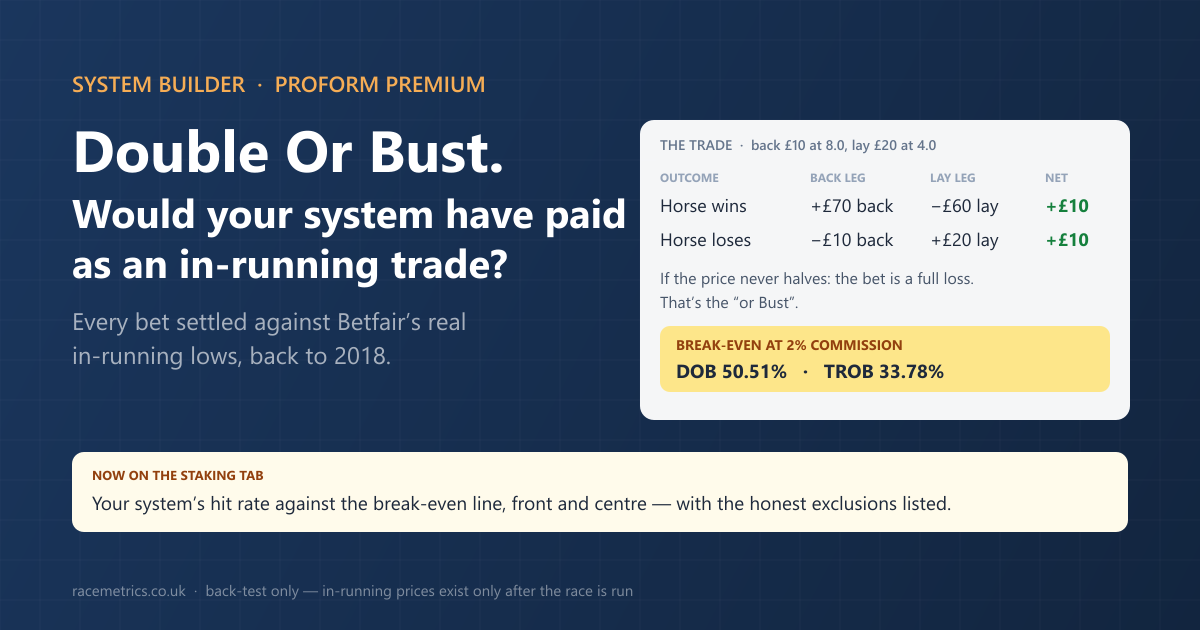
Some of the most popular exchange strategies in racing never wait for the result. Double Or Bust — DOB to everyone who trades it — backs a horse at Betfair SP and offers a lay at half the decimal odds in running. If the price ever trades at half, the lay is matched and the trade is locked: +1 point profit whatever happens next — the horse can fade, get outbattled, even fall, and the profit is already banked. If the price never halves, the bet is a full loss. That's the "or Bust".
From today, the System Builder can settle any system you can build as exactly that trade — against Betfair's real recorded in-running low for every runner in every UK and Irish race since January 2018.
The arithmetic that makes it interesting
Back £10 at decimal 8.0 and lay £20 at 4.0:
| Outcome | Back leg | Lay leg | Net |
|---|---|---|---|
| Horse wins | +£70 | −£60 liability | +£10 |
| Horse loses | −£10 | +£20 stake | +£10 |
The payoff is the same either way — one point, whatever the price of the horse. Which means the entire strategy collapses into a single question: how often does the price halve? At 2% commission the break-even hit rate is 50.51%. Clear it and you profit; miss it and you don't. There is no other lever.
Treble Or Bust (TROB) is the same trade at a third of the odds: hits are rarer, but each one locks +2 points, so the break-even drops to 33.78%.
The honest baseline — most runners don't halve
Before you test anything, know the base rate. Across every priced runner in the database since 2018 — over a million runs — just 38% traded at half their BSP in running, against the 50.51% needed. Blanket DOB on every horse loses about 25p in the pound; the market prices the likelihood of in-running shortening just as sharply as it prices winning. TROB is the same story: 25% hit rate against 33.78% needed.
The hit rate is also U-shaped in price — strongest at both ends of the market and weakest in the middle:
| BSP (decimal) | Runs | DOB hit rate |
|---|---|---|
| 2.02–3 | 37,437 | 46.1% |
| 3–5 | 104,317 | 41.5% |
| 5–10 | 228,124 | 36.4% |
| 10–20 | 229,409 | 33.7% |
| 20–50 | 203,969 | 36.3% |
| 50+ | 213,682 | 42.6% |
None of those bands clears break-even on its own. That's the point of putting DOB in the System Builder rather than publishing a list: a blanket rule doesn't pay, so the question worth asking is whether your angle — the front-runners, the well-backed, the course specialists, whatever your rules find — trades short often enough to clear the line. Now you can answer it against nine seasons of real in-running data instead of guessing.
What the Staking tab shows you
Pick Double Or Bust (DOB) or Treble Or Bust (TROB) as the bet type on the Staking tab and every bet your system matched is settled as the trade. The headline is impossible to miss: your hit rate against the break-even line, green or red, computed from your own commission setting — a member on 5% commission needs 51.3%, not 50.51%, and the tab says so.
Underneath, the full staking-plan comparison runs as normal — level stakes, percentage-of-bank, Fibonacci, loss recovery and the rest, with bank curves, drawdowns and the Monte-Carlo bust-risk reshuffle. Because a DOB losing run at a ~40% hit rate can be long, the progression plans are genuinely informative here. Kelly sits this one out: there's no quoted market for "will it trade at half", so there's no honest probability to feed it — and we'd rather leave a box empty than show you a curve fitted to its own answer.
The small print we settled carefully
Three conventions worth knowing, because they're where casual DOB back-tests go wrong:
- A winner that never halved is a loss. If your horse makes all and wins without its price ever trading at half, the lay never matched — you're left on a winning back bet, but the strategy as defined books it strictly as a miss. It's rare (about one eligible winner in nine hundred) but the convention matters, and the tab reports the count.
- Short-priced runners leave the count entirely. Betfair's minimum price is 1.01, so a horse at decimal 2.01 or shorter cannot halve — the lay leg is impossible. Those runners are excluded from the denominator rather than scored as losers (counting them as losses would quietly punish exactly the short-priced systems most likely to be tested). The excluded count is always shown, even when it's zero.
- Back-test only, by nature. An in-running price exists only after the race has been run, so a DOB result can never be known in advance — these modes deliberately never appear in your qualifiers. Your system's selections are still fully live-usable; this is a settlement view on history. And the model assumes your lay was matched at the target price — at a thinly traded low, real execution can be partial.
Try it on a system you already have
Open any saved system, run the back-test, and switch the Staking tab's bet type to DOB. Thirty seconds will tell you whether your angle trades short often enough to be interesting — and if it doesn't, that's a real answer too, learned on a million runs rather than a month of live stakes.
DOB and TROB are live now on the System Builder Staking tab for Proform Premium members. The full explainer — all six bet modes and all ten staking plans — is in the System Builder guide.