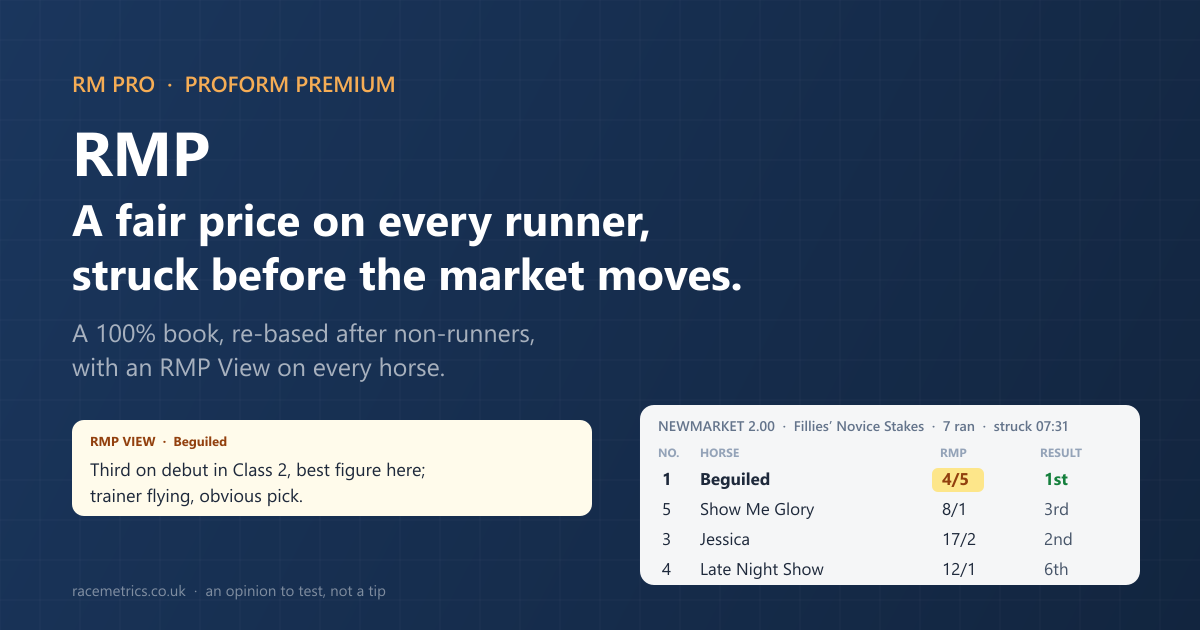
Every runner on every UK and Irish racecard now carries a price that nobody can bet to. That is the point of it.
RMP — the RaceMetrics Model Price — is struck each morning once the previous day's results are in and before the market has moved. It is a 100% book: the prices across a race add up to exactly 100%, with no bookmaker margin in them, so “4/1” means the model gives the horse a one-in-five chance, nothing more and nothing less. Next to every price sits an RMP View: one line, written at the same moment, on what the model saw in the horse.
What it reads
RMP draws on the same data you can already see on RaceMetrics: the RaceMetrics ratings for the horse and its connections, speed figures, the price it went off at last time, pace, Proform's compiled stats, the official rating, weight and days since a run, the horse's record at today's course, distance, going and class, 14-day trainer and jockey form, draw bias, headgear and recent activity. How those are weighed together is the model itself, and we do not publish it.
Where it appears
- On the racecard's Ratings, At-a-Glance and Form Expert views as an RMP column, gold for the model's top-rated in the race. Hover the ⓘ for the RMP View.
- In My Card as four columns under Prices — RMP, RMP Rk, RMP+Eve (blended with the evening show) and RMP View as a full column.
- On A-Z Runners, sortable across every declared runner, and on every past run in the form lines, so you can see what the model thought of a horse before each of its recent races.
- In the System Builder as its own filter group — rank, clear-by, and market-against-RMP — with breakdowns and drill-down columns, and in the qualifiers hub and the morning qualifiers email.
- In Ask RaceMetrics: “today's RMP top-rated” or “horses the market prices 20% bigger than RMP” are answered straight from the table.
On settled racecards the figure is exactly what was struck that morning, so you can always check what the model thought before the off. Fractional or decimal follows your usual Price Format setting, and if you prefer prices to look the way a price list does, Account → Preferences lets you add a display margin of 110%, 115% or 120%. That is presentation only; ranks, sorting, qualifiers and the System Builder always use the fair figure.
Non-runners, handled honestly
A withdrawal after the strike leaves every other price too big — the withdrawn horse's chance has to go somewhere. Roughly two races in five lose a runner between the morning strike and the off, so this is not an edge case. RMP is re-based over the runners actually left so the book sums to 100% again, the rank moves with it, and the figure you see is the one you could act on. Hover it and the struck price is still there. A horse that joins the field after the strike shows as not priced; the model never re-prices a race once struck.
What RMP is, and is not
RMP is an opinion to test, not a tip. Since 30 July it has priced every race as a forward test — 912 races and nearly 9,000 runners so far — and scored itself against the closing Betfair market the next morning. The raw model picks the eventual favourite in about half of races; blended with the bookmakers' evening show it predicts where the market will finish slightly better than the show does on its own. Every attempt so far to turn “RMP bigger than the bookies” into a profit at the close has come back level. The market is usually right.
Where RMP earns its place is in disagreement. A horse the model rates far shorter than the early market is a horse worth looking harder at, and the System Builder lets you test exactly those conditions on real results — with the bookmaker's margin taken out first, because their book carries one and RMP does not. Three weeks of history is three weeks; treat every figure as provisional and let it earn your trust race by race.
Who gets it
RMP is part of RaceMetrics Pro and Proform Premium. Everyone else sees the column in place with the morning's strike time, so you know it is there. It is live now — open any racecard.