
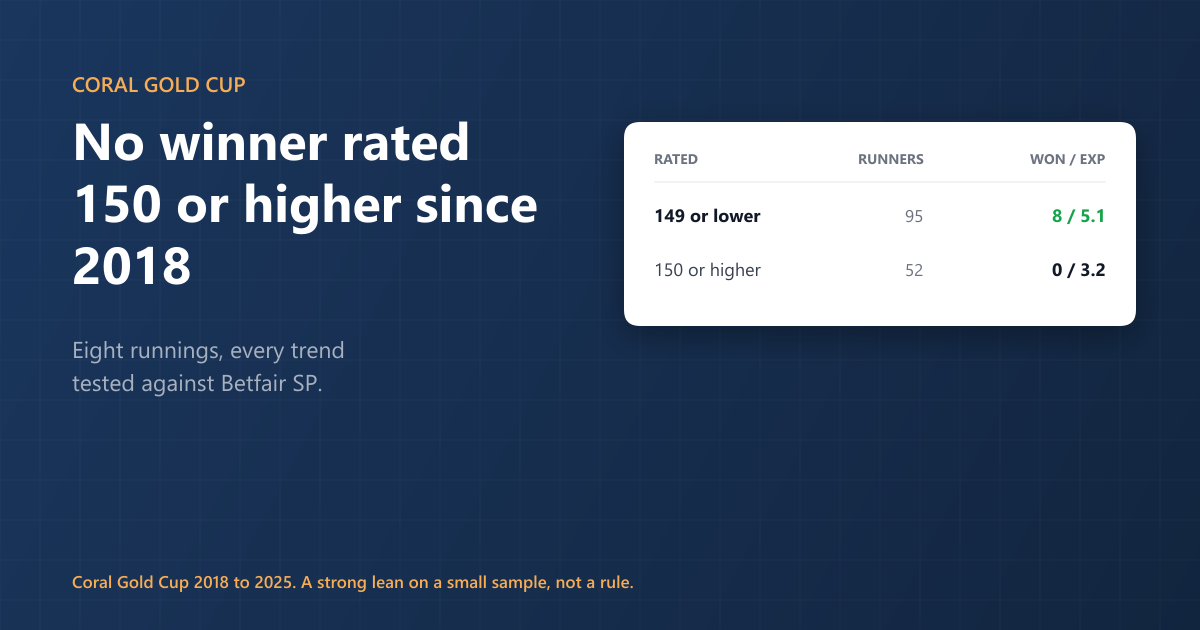
Most Coral Gold Cup trends either describe the whole field or are already in the price, once you test them on the race and on more than 1,400 runners in similar staying handicap chases. The one that has paid is the ceiling on the handicap mark: no horse rated 150 or higher has won it since 2018, and the market has kept expecting them to.
“Plenty of winners live long in the memory, but no more so than dual winner Denman. The second win, off top weight, was a sight to behold.”
Simon Walton, RaceMetrics founder
Denman made top weight look easy. Since 2018 it has been harder. Horses carrying 11st or more have won 3 of their 70 runs in this race, against the 4.6 their Betfair prices expected (A/E 0.65). That is a small sample, and in similar staying handicap chases the big weights have been fairly priced (A/E 0.96 from 714 runs).
How to read the numbers. Every figure is measured against Betfair SP, which carries no bookmaker margin, so it is the fairest price to judge a group of horses against. A/E (actual over expected) is winners divided by the winners the prices said there should be: 1.00 is par, 1.10 means 10% more winners than the market expected. The ± figure is one standard error, roughly how far the number could wander by luck alone. A result inside two standard errors of 1.00 is not a finding.
Level stakes is the profit or loss from a 1-point win bet on every horse in the group, at Betfair SP after 2% commission and at industry SP.
The race
The Coral Gold Cup is Newbury's premier staying handicap chase, run over about three and a quarter miles (3m1f214y on our records) at the end of November or the start of December. For most of its history it was the Hennessy. It was the Ladbrokes Trophy from 2017 to 2021 and has been the Coral Gold Cup since 2022. We found every running by course, month, race type, trip and class rather than by title.
Our race records start in 2018: eight runnings and 147 runners.
| Year | Winner | Age | Weight / OR | SP | Betfair SP | Last run | Days off |
|---|---|---|---|---|---|---|---|
| 2018 | Sizing Tennessee | 10 | 11-3 / 148 | 12/1 | 17.4 | Won, chase, Fontwell | 57 |
| 2019 | De Rasher Counter | 7 | 10-10 / 149 | 12/1 | 20.1 | 6th, hurdle, Uttoxeter | 43 |
| 2020 | Cloth Cap | 8 | 10-0 / 136 | 9/1 | 10.1 | 3rd, chase, Cheltenham | 35 |
| 2021 | Cloudy Glen | 8 | 10-8 / 140 | 33/1 | 38.6 | Pulled up, chase, Aintree | 231 |
| 2022 | Le Milos | 7 | 11-0 / 146 | 9/2 fav | 6.2 | Won, chase, Bangor-on-Dee | 17 |
| 2023 | Datsalrightgino | 7 | 10-7 / 148 | 16/1 | 26.0 | 8th, chase, Aintree | 34 |
| 2024 | Kandoo Kid | 8 | 11-5 / 145 | 8/1 | 10.9 | 3rd, chase, Aintree | 232 |
| 2025 | Panic Attack | 9 | 10-5 / 139 | 16/1 | 22.0 | Won, chase, Cheltenham | 14 |
Weight is the weight carried, after any jockey's claim. Betfair SP is shown as decimal odds.
This is a race for prices. Five of the eight winners returned 12/1 or bigger, and only one favourite has won. Last year's winner, Panic Attack, had won the Paddy Power Gold Cup at Cheltenham a fortnight earlier.
The trends, checked against the winners
| The claim | Our count, 2018 to 2025 |
|---|---|
| Winners are aged 8 or younger | 6 of 8 |
| Winners are rated below 150 | 8 of 8 |
| Winners had run in fewer than ten chases | 7 of 8 that we can see |
| Winners had one run that season | 6 of 8 (the other two were first time out) |
| Many winners carried 11st or more | 3 of 8 |
Four of the five hold up on our count. The weight trend, which covers a longer history in the trend pieces, has not held lately. None of this yet tells us whether the winners were a surprise to the market.
Inside the race: what the market expected
| Coral Gold Cup, 2018 to 2025 | Winners | Runners | Expected winners | A/E | Level stakes, Betfair SP | Level stakes, SP |
|---|---|---|---|---|---|---|
| Every runner | 8 | 147 | 8.2 | 0.97 | +2% | −19% |
| Aged 8 or younger | 6 | 112 (76%) | 7.0 | 0.86 ±0.38 | −1% | −21% |
| Rated 149 or lower | 8 | 95 (65%) | 5.1 | 1.58 ±0.44 | +58% | +25% |
| Rated 150 or higher | 0 | 52 (35%) | 3.2 | 0.00 | −100% | −100% |
| Fewer than ten chase runs | 7 | 95 (65%) | 6.3 | 1.11 ±0.40 | +18% | −11% |
| One run in the previous 90 days | 6 | 91 (62%) | 5.6 | 1.08 ±0.42 | +11% | −17% |
| Carrying 11st or more | 3 | 70 (48%) | 4.6 | 0.65 ±0.47 | −51% | −61% |
One line stands out. The 52 runners rated 150 or higher were given 3.2 winners' worth of chance by the exchange and won none. Every winner came from the 149-and-below group, which returned a profit at both prices. The young-horse trend, by contrast, came in under par: 6 winners from 7.0 expected.
Eight races is still eight races. Three expected winners failing to arrive happens by chance about one time in twenty-five, and we looked at several lines before this one stood out. So we widened the test.
Across similar races
The comparison set is every British and Irish Class 1 or Class 2 handicap chase from three miles to 3m3f, run in November or December since 2018: 119 races and 1,421 runners.
| Class 1 and 2 handicap chases, 3m to 3m3f, Nov and Dec | Runners | Strike rate | Rest of field | A/E | Level stakes, Betfair SP | Level stakes, SP |
|---|---|---|---|---|---|---|
| Every runner | 1,421 | 8.4% | 0.99 | −6% | −26% | |
| Aged 8 or younger | 834 | 8.6% | 8.0% | 0.98 ±0.12 | −16% | −28% |
| Rated 149 or lower | 1,290 | 8.7% | 5.3% | 1.03 ±0.10 | −4% | −25% |
| Rated 150 or higher | 131 | 5.3% | 8.7% | 0.62 ±0.30 | −16% | −34% |
| Fewer than ten chase runs (2022 on) | 322 | 10.2% | 7.0% | 1.08 ±0.18 | −4% | −22% |
| One run in the previous 90 days | 611 | 8.3% | 8.4% | 0.99 ±0.14 | −5% | −25% |
| Carrying 11st or more | 714 | 9.2% | 7.5% | 0.96 ±0.12 | 0% | −25% |
- Age and the one-prep-run trend are not real. Younger horses and horses with one recent run win at the same rate as everyone else, and the market prices them almost exactly: 0.98 and 0.99.
- Lightly raced chasers and heavier weights do win more often, 10.2% against 7.0% and 9.2% against 7.5%. But both are priced for it. Horses with fewer than ten chase runs score 1.08, under half a standard error from par.
- The high-rated horses keep falling short. Across similar races, horses rated 150 or higher won 7 times from 11.2 expected, an A/E of 0.62, and lost a third of their stakes at industry SP. That points the same way as the race itself.
Two cautions on that last line. The Coral Gold Cup is inside the comparison set, so the two findings are not fully independent. And at 0.62 ±0.30 the wider figure is just over one standard error from par. It is the strongest pattern in this post, and it is still not proof.
The verdict on each trend
| Trend | Verdict |
|---|---|
| Aged 8 or younger | Not real. Younger horses win at the same rate and are priced to. |
| Rated below 150 | Real, and it has paid. The sample is small, so treat it as a strong lean, not a rule. |
| Fewer than ten chase runs | Real but priced in. |
| One run that season | Not real. |
| Carrying 11st or more | Real in similar races but priced in, and it has gone the wrong way in this race lately. |
What does not matter here: how the horse is ridden
At Cheltenham over two and a half miles, horses that are usually held up have run below their prices (see our Paddy Power Gold Cup trends). Over three miles and more in races of this class, that disappears. Usual front-runners scored 1.06, prominent racers 1.02 and held-up horses 0.95, all within the noise. In the Coral Gold Cup itself, four of the eight winners were horses usually ridden from off the pace. Run style is a reason to look twice at a two-and-a-half-mile handicap. At this trip it is not.
How to use this on the day
- Build the comparison in the System Builder. Race Type Chase, Handicap Yes, Distance (furlongs) 24 to 27, Class 1 to 2, Month November and December.
- Add the rating rule. Official Rating 150 or more shows the group the market has overrated. Then look at OR vs Top-Rated in Race on the Breakdown, which shows the same thing as weight received rather than a fixed mark.
- Check the other trends one at a time: Age, Chase Runs (career), Runs in Last 90 Days, Weight Carried. Watch the A/E, not the strike rate.
- On the day, open the race's Race Guide and racecard. Check each runner's mark, its chase experience and its price. RMP is an opinion to test against the market, not a tip, and it has no history in this race yet.
- Save the system as Active and its qualifiers will show on the day for this race and every similar one.
The take
Most of the Coral Gold Cup trends are true and useless: they describe most of the field, or they describe horses the market already rates. The exception is the mark. Since 2018 the race has gone to horses rated 149 or lower every year, and the high-rated horses have also underperformed their prices in similar races. That is the line worth carrying into the race, with the honest note that it rests on a small number of winners.
Questions we get asked about this
Do top-rated horses win the Coral Gold Cup?
Not recently. All eight winners from 2018 to 2025 were rated 149 or lower. The 52 runners rated 150 or higher had 3.2 winners' worth of chance at Betfair SP and won none.
What age wins the Coral Gold Cup?
Six of the last eight winners were aged 8 or younger, but they were 76% of the runners. In similar staying handicap chases younger horses win at about the same rate as older ones, with an A/E of 0.98.
Is the Coral Gold Cup the same race as the Hennessy and the Ladbrokes Trophy?
Yes. It is the same Newbury handicap chase over about three and a quarter miles. It was the Hennessy Gold Cup for most of its history, the Ladbrokes Trophy from 2017 to 2021 and the Coral Gold Cup from 2022.