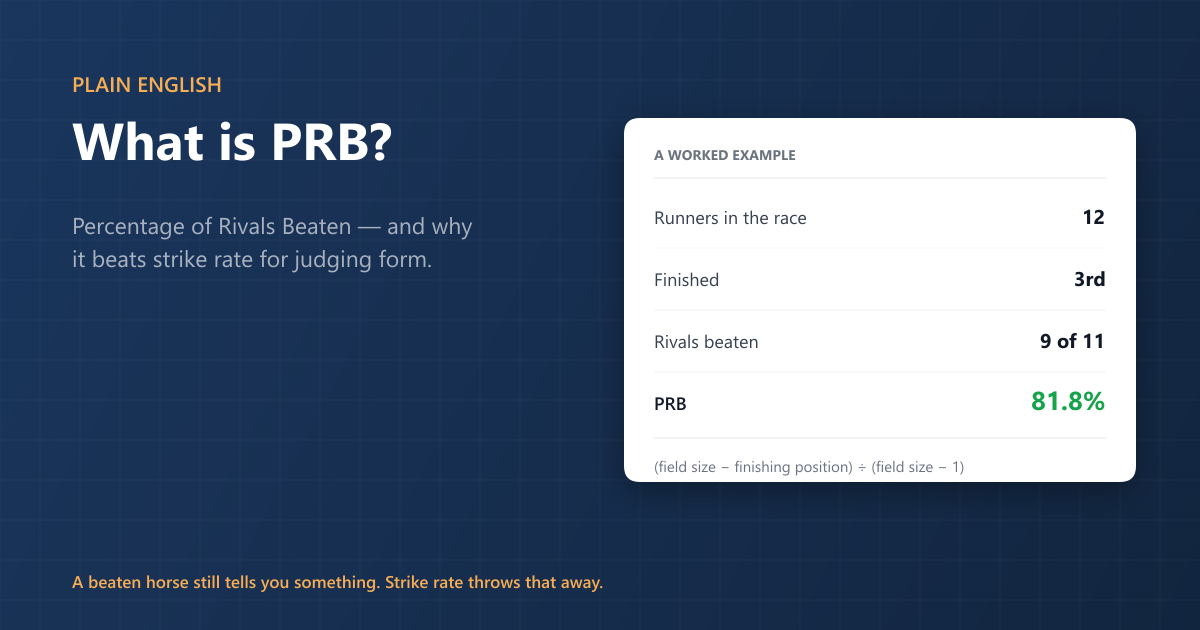
PRB stands for Percentage of Rivals Beaten. It answers a simple question about any run: of the horses this one raced against, what percentage did it finish in front of?
The formula
PRB = (field size − finishing position) ÷ (field size − 1) × 100
Worked examples:
- Win a 10-runner race: (10 − 1) ÷ 9 × 100 = 100% — you beat everyone.
- 3rd of 12: (12 − 3) ÷ 11 × 100 = 81.8% — beat 9 of 11 rivals.
- 5th of 6: (6 − 5) ÷ 5 × 100 = 20%.
- Last, or failed to finish: 0%.
Why PRB beats win strike-rate
- It's fair across field sizes. Finishing 4th of 20 (84.2% PRB) is a much better run than 4th of 5 (25%) — raw finishing position treats them the same; PRB doesn't.
- It uses every run, not just wins. Win strike-rate throws away everything below 1st place. A horse running consistent 2nds and 3rds in big fields shows a high average PRB long before it wins — often exactly when it's still a big price.
- It's continuous. Averaging PRB across a trainer's last month, a sire's runners on soft ground, or a jockey's record at a track gives a stable, comparable number where win percentages jump around on small samples.
The evidence, measured
The second point above — that PRB grades defeats, where a strike rate cannot — can be tested directly rather than asserted. Take every runner in Britain and Ireland over the six months to the end of August 2026 that had run before, 58,594 of them. Band each one by the PRB of its previous run, then measure how often it won this time.
| PRB last time | Runs | Won next time |
|---|---|---|
| 90–100% | 8,848 | 18.2% |
| 75–90% | 8,924 | 16.1% |
| 55–75% | 10,030 | 12.5% |
| 45–55% | 5,053 | 10.2% |
| 25–45% | 10,889 | 8.4% |
| Under 25% | 14,850 | 5.7% |
The top band is the least interesting one: three-quarters of it is horses that actually won last time, and a strike rate would have told you that much. The point is everything below it. Not one horse in the bottom five bands won last time out — every one of them was beaten, and "beaten last time" describes all of them identically. Ranked purely by how much of the field they got past, their win rate next time runs from 16.1% down to 5.7%, very nearly three to one.
That is the case for the number in a single table. It grades defeats, and most of a form book is defeats.
PRB², the dominance version
Alongside PRB you will sometimes see PRB². Same idea, but each run's rivals-beaten ratio is squared before averaging, which pulls the reward sharply towards dominant performances and away from merely respectable ones.
In practice: a horse that runs a string of honest fourths shows a decent PRB and a modest PRB². A horse with two thumping wins among some duds shows a similar PRB and a far higher PRB². It answers a different question — not "does it usually run well" but "does it have a big performance in it". Because squaring compresses the scale, a good PRB² reads lower than a good PRB.
How RaceMetrics uses PRB
PRB is a foundation of the RaceMetrics rating methodology: our Elo-based ratings update on the gap between a horse's expected PRB (from its rating versus the field's) and its actual PRB. It also powers the Race Workout tool, which averages the subsequent-run PRBs of a race's runners to judge how well the form is working out, and appears as a mode in Form Expert for judging records under today's conditions.
PRB quick reference
| Average PRB | Reading |
|---|---|
| 60%+ | Consistently beating most rivals — genuine ability for the level |
| 50–60% | Better than average; competitive at the level |
| 40–50% | Around average |
| Below 40% | Struggling at the level — needs a drop in class or a change |
FAQ
What does PRB mean in horse racing?
PRB means Percentage of Rivals Beaten — the share of a race's other runners that a horse finished ahead of, calculated as (field size − finishing position) ÷ (field size − 1) × 100.
Is a high PRB good?
Yes. 100% means the horse won; anything consistently above 50% means it beats most of its rivals. Non-finishers score 0%.
What is PRB²?
PRB² squares each run's rivals-beaten ratio before averaging, so dominant performances count for much more than consistent modest ones. A horse with a high PRB and a low PRB² is reliable; one with a high PRB² has a standout run in it.
Where can I see PRB stats for UK horses?
RaceMetrics shows PRB in its Form Expert view (as a selectable mode alongside win and place), in the Race Workout tool, and throughout its Elo-based rating methodology. There's a free tier to try it.