The Thursday Take is our weekly column: one racing talking point, put to the test against the Proform database. This is a Saturday special — on the big meeting days we take the week’s finding and point it at the actual card, once the fields are up and the guesswork is over.
The short version
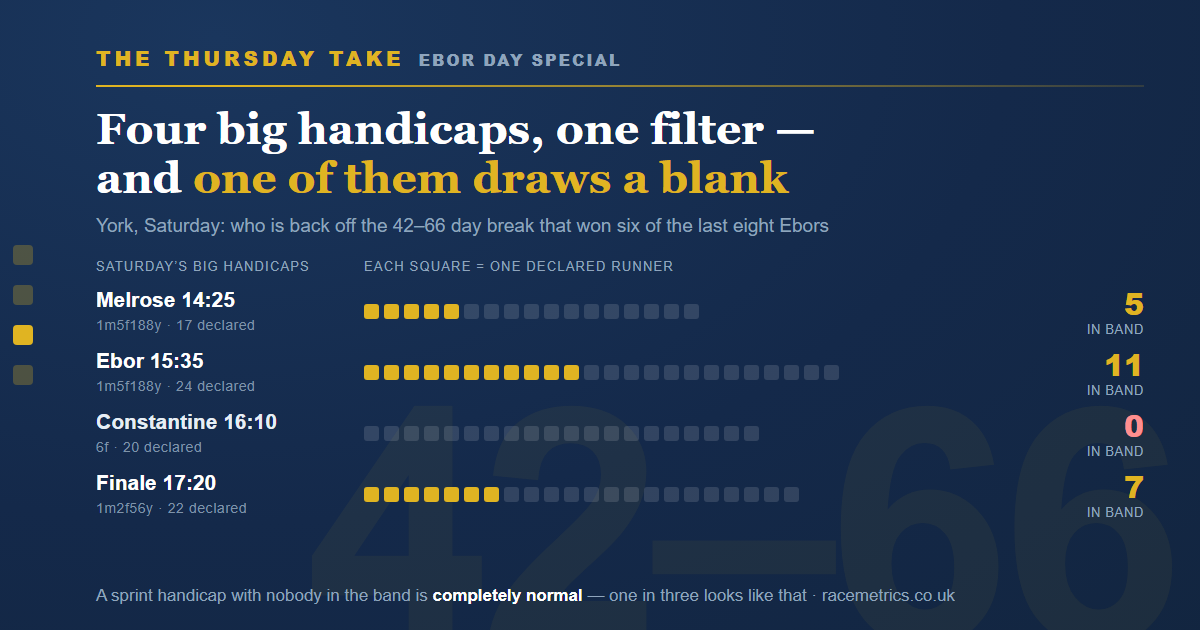
- York stages four big-field Flat handicaps on Saturday 22 August 2026 — the Melrose (17 declared, 1m5f188y), the £500,000 Sky Bet Ebor (24 declared, 1m5f188y), the Constantine (20 declared, 6f) and the Dav Reid Finale (22 declared, 1m2f56y). In a year when the big-field handicap has become a rarer animal, that is four of them in one afternoon.
- Thursday’s finding, in one line: across 45,467 runners in British 14+ runner Flat handicaps since 2018, horses returning after a 42 to 66 day break are the best-priced group in the race at an A/E of 1.097, while horses back after 14 to 27 days are the biggest group and the worst priced at 0.933. Both sit inside the same widely-quoted trend, “ran within 66 days”.
- New this morning: that gap gets wider the further they go. The spread between the two bands is 0.120 in sprints, 0.194 at middle distances and 0.240 over 12 furlongs and beyond, where the 42–66 day band returns an A/E of 1.125 and the 14–27 day band returns 0.885. The Ebor and the Melrose are both 1m5f188y races.
- In the Ebor, 11 of the 24 declared runners are in the 42–66 day band, and 8 of those 11 are also aged four to six — the age profile that has produced 16 of the last 17 winners. Over those 17 runnings the band has supplied 36.6% of the runners but 47.1% of the winners.
- The Constantine has nobody in the band at all — and that is completely normal, not a quirk. Sprint handicaps run their horses more often: one British sprint handicap in three has an empty 42–66 day band.
- This is a pricing observation, not a tip. Eleven horses in a twenty-two-runner race is not a selection. The band tells you which runners the market has historically been slow to charge for; it does not tell you which one wins.
- Build it: Field Size 14–40, Handicap = Yes, Course Country = GB, Days Since Last Run 42–66, and add Distance (furlongs) 12–40 for the staying version.
Saturday morning update
The overnight non-runners are in, and none of them changes anything below. Both Ebor reserves — Enemy and Dancing In Paris — have come out, so the Ebor is run at its maximum field of twenty-two and all eleven horses in the 42–66 day band stand. King’s Code, nine days off a run and therefore in neither band, is out of the Finale, which leaves twenty-one there with the same seven qualifiers. The Melrose and the Constantine are unchanged at seventeen and twenty. Checked 10:15 on Saturday 22 August.
Four big handicaps, one afternoon
Rory Delargy has made the point in the Irish Field that field shapes and ground are the great unknowns of Ebor week, which is what makes the ante-post market on a race like this so fraught. Quite so — which is why this column waits. The fields are up now, the guessing is over, and the counting can start.
Saturday’s Knavesmire card carries four handicaps with fourteen or more declared runners:
| Off | Race | Declared | Distance |
|---|---|---|---|
| 14:25 | Sky Bet Melrose Handicap | 17 | 1m5f188y |
| 15:35 | Sky Bet Ebor Handicap | 24 | 1m5f188y |
| 16:10 | Sky Bet Constantine Handicap | 20 | 6f |
| 17:20 | Sky Bet Dav Reid Finale Handicap | 22 | 1m2f56y |
That matters more than it used to. Britain staged an average of 423.6 Flat handicaps with fourteen or more runners each year between 2015 and 2019; between 2023 and 2025 the average was 281.3, a fall of a third. The number of Flat handicaps has actually gone up over that period, and the average field size has barely moved — what has gone is specifically the big one. York putting four of them on a single card is now a genuinely unusual afternoon.
One factual note on the ground, and then we will leave it alone: all four races are officially Good to Soft as declared. Since 1 July, only 22 of 1,229 British turf races have been run on Good to Soft or easier, so this is a card running against the grain of a very fast summer. That summer is next Thursday’s column, and it deserves the space.
What we found on Thursday, restated
Thursday’s piece tested the trends that get published about the Ebor every August — aged four to six, ran within 66 days, three or more runs this season, won over the trip — against every British Flat handicap of fourteen or more runners since 2018. That is 2,880 races and 45,467 runners, with a Betfair Starting Price on 99.9% of them.
The trends held up. Stacking all four lifts the strike rate from 4.95% to 6.92%, about forty per cent better. But the A/E came out at 1.007 against a baseline of 0.998 — you are paying a fair price for a better horse, which is what an efficiently priced market is supposed to do to you.
The interesting part was underneath. “Ran within 66 days” describes 85.1% of the entire field, and it contains both the worst-priced group in the race and the best:
| Days since last run | % of field | Strike rate | A/E |
|---|---|---|---|
| 0–13 | 21.0% | 7.49% | 1.005 |
| 14–27 | 39.3% | 6.04% | 0.933 |
| 28–41 | 16.1% | 6.52% | 1.037 |
| 42–66 | 8.8% | 6.62% | 1.097 |
| 120+ | 10.7% | 5.46% | 1.092 |
A/E, in plain English. Add up what the betting market thought each horse’s chance was, then compare it with how many actually won. 1.00 means the market had it exactly right. Below 1.00 means you were paying over the odds; above means the group won more often than its prices implied. It is a fairness score, not a profit — and unlike return on investment it cannot be dragged around by one enormous winner.
New this morning: the gap widens with distance
Thursday pooled every distance together. The Ebor is a staying handicap, so we split it, and the finding gets stronger rather than weaker as the trips get longer:
| Distance | 14–27 days | 42–66 days | Gap |
|---|---|---|---|
| Sprints, under 8f | 0.952 | 1.072 | 0.120 |
| Middle distances, 8–11.9f | 0.920 | 1.114 | 0.194 |
| Staying, 12f and up | 0.885 | 1.125 | 0.240 |
Which makes intuitive sense. A staying handicapper is a horse you campaign, not a horse you run every fortnight, and the ones being aimed at a target are the ones you would expect to be underestimated. The two 1m5f188y races on Saturday sit in the bottom row.
The honest caveat. That staying 42–66 cell is 705 runners — the smallest box in the table. The direction is consistent with the two larger bands above it, which is why we are willing to quote it, but it is not a big sample and we are not going to pretend it is one.
The Ebor: 11 of the 24
Our database holds every Ebor back to 1997, with a Betfair Starting Price from 2009 — seventeen usable runnings. Across those seventeen years the 42–66 day band supplied 123 of 336 runners, 36.6% of the field, and 47.1% of the winners. The 14–27 day band supplied 41.4% of the runners and 23.5% of the winners. Same race, opposite directions.
Eight of those seventeen winners came off a 42–66 day break, and six of them are the last eight runnings: 2018 (44 days), 2019 (57), 2020 (66), 2021 (42), 2024 (45) and 2025 (64). The two misses were 2022 on 21 days and 2023 on 25.
Here are the eleven of Saturday’s twenty-four who fit. A star marks the eight who are also aged four to six — the profile that has produced sixteen of the last seventeen winners.
| No. | Horse | Age | Days | OR | Draw | Trainer | Jockey |
|---|---|---|---|---|---|---|---|
| 2 | Epic Poet | 7 | 42 | 109 | 7 | David O’Meara | Daniel Tudhope |
| 3 | Paradias | 7 | 50 | 107 | 2 | Alan King | Kieran Shoemark |
| 4 | Furthur ★ | 4 | 50 | 106 | 16 | Andrew Balding | Oisin Murphy |
| 10 | Emit ★ | 4 | 64 | 104 | 11 | Joseph Patrick O’Brien | Ryan Moore |
| 11 | Paddy The Squire ★ | 6 | 49 | 104 | 14 | Iain Jardine | Andrew Mullen |
| 12 | Poetic Sound ★ | 5 | 57 | 102 | 22 | G M Lyons | Gary Carroll |
| 15 | Beylerbeyi ★ | 6 | 43 | 101 | 21 | Ian Williams | Clifford Lee |
| 17 | Klassleader ★ | 4 | 49 | 98 | 13 | William Haggas | Tom Marquand |
| 19 | Square Necker ★ | 4 | 63 | 97 | 23 | Kevin Foy | D Egan |
| 20 | Real Dream | 7 | 43 | 96 | 10 | Ian Williams | Cieren Fallon |
| 21 | Circus Of Rome ★ | 4 | 56 | 96 | 8 | Richard Hughes | Jamie Spencer |
Three things about that list which we are not going to bury:
- Cards 23 and 24 are reserves. Enemy and Dancing In Paris are down as Reserve 1 and Reserve 2, and the race has a maximum field of twenty-two, so at least two of the twenty-four will not run. Both reserves are fourteen days off their last start, so if they do get in they land in the 14–27 band and the list above is unchanged either way.
- One runner cannot be placed in a band at all. Love Me Tender, the German-bred four-year-old carrying card 22, has no previous run recorded in our database, so we have no days-since-last-run figure for it. We are telling you that rather than quietly dropping it out of the count.
- Eleven of twenty-four is a high share, but it is not remarkable. The Ebor is always a race horses are freshened for — its 36.6% historical share of the band compares with 12.5% in British staying handicaps generally. Fields of eleven-in-the-band have happened before, in 2012 and 2019. This is a normal Ebor, not a strange one.
And the band is not a rule. The 2015 Ebor was won by a horse coming back from a 491-day absence. If you want one sentence to keep this in proportion, that is the one.
The Melrose: 5 of 17, and a check we had to run
The Melrose is a three-year-old-only handicap, so the “aged four to six” trend has nothing to say about it. The layoff band, though, is not an age argument — and it survives on its own in three-year-old company: A/E 1.134 for the 42–66 day band against 0.954 for 14–27. That is 555 runners in the good band, so again, a real finding on a modest sample.
Five of the seventeen declared qualify: Limestone (66 days, OR 105, Joseph Patrick O’Brien / Ryan Moore), Mythical Bay (49, OR 92, Andrew Balding / Oisin Murphy), Galilean Quality (42, OR 91, K R Burke / S H James), Who’s Lope (56, OR 86, Andrew Balding / Nicola Currie) and Bay Of Stars (63, OR 86, D K Weld / Ray Dawson).
The Constantine: nobody, and that is the normal answer
Run the twenty declared runners in the six-furlong Constantine through the same filter and the answer is zero. Not one horse in the race has been off between 42 and 66 days. Eleven of the twenty are in the 14–27 day band.
This is the most useful thing on the page, because it is the result that stops the filter being treated as a horoscope. Sprinters are campaigned differently — they run more often, and they are rarely put away for two months and brought back for a target. In British sprint handicaps of fourteen or more runners, the 42–66 day band accounts for just 7.55% of runners, and a third of those races have nobody in it at all. Over twelve furlongs the same band is 12.47% of the field and only one race in five draws a blank.
So the Constantine is not an anomaly and it is not a warning. It is a sprint. If a filter only ever hands you names, it is not telling you anything.
The Finale: 7 of 22
The closing 1m2f56y handicap has seven in the band, five of them also aged four to six: Raammee (4yo, 42 days, OR 103, Roger Varian / Ray Dawson), Thunder Run (5, 42, OR 101, K R Burke / Clifford Lee), Erzindjan (8, 66, OR 101, Terry Kent / Ryan Moore), Have Secret (6, 42, OR 93, Richard Fahey / Jamie Spencer), Sujet (4, 42, OR 89, Declan Carroll / Zak Wheatley), Dark Moon Rising (7, 43, OR 87, Kevin Ryan / Shane Gray) and Rainbow Nebula (4, 42, OR 85, Richard Fahey / Cam Hardie).
What this is, and what it very much is not
This is not a tip sheet. Eleven horses in a twenty-two-runner race is not a selection, and we have not looked at a single price — Saturday’s markets did not exist when these numbers were run.
It is a statement about pricing, not about winning. An A/E above 1.00 says a group has historically won more often than its odds implied. It does not say the group wins often: the 42–66 day band still only wins about one race in fifteen, the same as everybody else. What it says is that when one of them does win, you have tended to be paid more than you should have been.
And it is one factor among many. Ground, trip, draw, weight, the handicapper and the trainer’s intentions all matter, and this column has deliberately left the draw out because draw bias is specific to a track and a distance — what a double-figure stall means over 1m6f at York is not what it means in a fourteen-runner sprint, and pooling the two would be worse than saying nothing.
Build it yourself
Every number above comes out of the RaceMetrics System Builder, and you can rebuild it in about a minute. The general version:
| Filter | Setting |
|---|---|
| Race Type | Turf + All-Weather |
| Handicap | Yes |
| Field Size | 14 to 40 |
| Race Lower Age Limit | 3 to 20 |
| Course Country | GB |
| Days Since Last Run | 42 to 66 |
For the staying version in this article, add Distance (furlongs) 12 to 40. For the Ebor’s own age profile, add Age 4 to 6. Then set the breakdown dimension to Days Since Last Run and you will see the whole ladder — including the 14–27 day trough — laid out for whatever cohort you have built.
The System Builder also flags every qualifying runner on today’s and tomorrow’s cards, which is how the tables above were produced. It is part of Proform Premium — see what is included.
FAQ
Which Ebor 2026 runners are in the 42-66 day band?
Eleven of the twenty-four declared for the 2026 Sky Bet Ebor at York returned to the racecourse between 42 and 66 days before the race: Epic Poet, Paradias, Furthur, Emit, Paddy The Squire, Poetic Sound, Beylerbeyi, Klassleader, Square Necker, Real Dream and Circus Of Rome. Eight of those eleven — all but Epic Poet, Paradias and Real Dream — are also aged between four and six, the age band that has produced sixteen of the last seventeen winners.
How many days off should an Ebor winner have had?
Eight of the last seventeen Ebor winners, and six of the last eight, came back off a break of between 42 and 66 days. Across the wider population of British 14+ runner Flat handicaps since 2018, that band returns an A/E of 1.097 while representing only 8.8% of runners, making it the best-priced group in the race. The commonly published trend is simply “ran within 66 days”, which covers 85.1% of all runners and therefore says very little.
Does the layoff effect differ by race distance?
Yes, and it grows with distance. Comparing the 42–66 day band with the 14–27 day band, the A/E gap is 0.120 in sprints under eight furlongs, 0.194 at middle distances, and 0.240 over twelve furlongs and beyond, where the two bands return 1.125 and 0.885 respectively. Staying handicappers are campaigned towards targets rather than run every fortnight, which is the likeliest explanation.
Why does the Constantine Handicap have no runners in the 42-66 day band?
Because it is a sprint. Sprint handicappers run far more frequently than staying horses, so the 42–66 day band accounts for only 7.55% of runners in British sprint handicaps of 14 or more, and a third of such races have nobody in the band at all. Over twelve furlongs the same band covers 12.47% of the field and only one race in five is empty. An empty band in a six-furlong handicap is the normal outcome, not a signal.
Is the 42-66 day band a betting system?
No. It is a statement about how the market prices a group of horses, not a selection method. Horses in the band win about one race in fifteen, much the same as horses outside it; the difference is that they have historically been returned at bigger prices than their win rate justified. Used on its own, without regard to ground, trip, draw, weight or fitness, it will not produce a profit.
The Thursday Take runs every Thursday morning, with a special whenever the big meetings come around. Population figures: GB Flat handicaps with 14 or more declared runners, open to 3yo+, 1 January 2018 – 17 August 2026, Proform database — 2,880 races and 45,467 runners. Ebor figures: 17 runnings, 2009–2025. Declared fields as at Friday 21 August 2026 and subject to non-runners. A/E calculated at Betfair Starting Price including all starters, non-finishers included.