The Thursday Take is our weekly column: one racing talking point, put to the test against the Proform database. This is a Saturday special. On the big meeting days we take the week's finding and point it at the actual card, once the fields and the stalls are known.
The short version
- The 2026 Ladbrokes Ayr Gold Cup is at 15:40 on Saturday 19 September: 25 declared over six furlongs, stalls 1 to 25, officially Soft on Friday morning. The Silver Cup is run over the same course and distance at 14:30, with 25 declared.
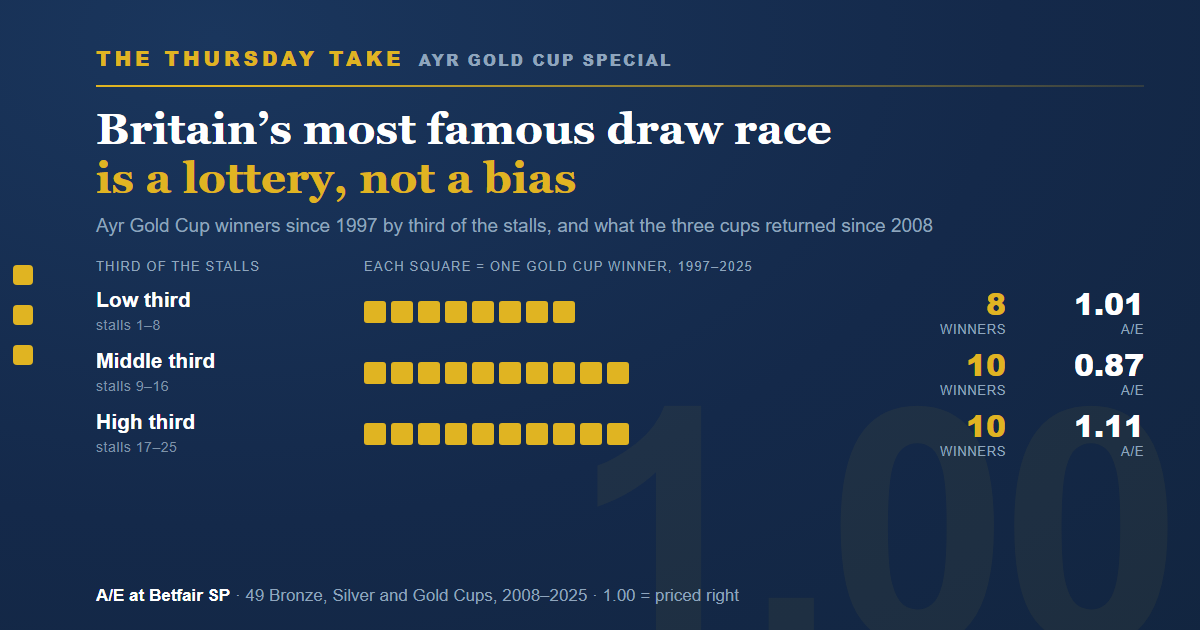
- The winners' stalls show no pattern. Of the 28 Gold Cups in our data since 1997 (2017 was abandoned), the winner came from the low third of the stalls 8 times, the middle third 10 times and the high third 10 times.
- The market already prices it. Across all 49 Bronze, Silver and Gold Cups since 2008 (1,204 runners), the low, middle and high thirds return an A/E of 1.01, 0.87 and 1.11 at Betfair Starting Price. Each figure rests on 14 to 19 winners, so none of them is distinguishable from 1.00.
- An earlier cup is a weak guide to the side. Since 2010, the third that supplied most of the Silver Cup's first four supplied 39% of the Gold Cup's first four, against 33% by chance. That is within one standard error. Friday's Bronze Cup did worse than chance: 25%.
- So this is a race to bet on the horse, not the stall. Last year's winner, Run Boy Run, won from stall 6 and is drawn 23 this time. If the draw decided the Gold Cup, his price would have to swing with it.
- Build it: in the System Builder, set Course = Ayr, Distance to Nearest Furlong = 6, Field Size 20 or more, Handicap = Yes, then open the Draw (stall) breakdown and the Holdout Check.
The draw argument, every September
No British handicap is talked about in terms of the draw more than the Ayr Gold Cup. Twenty-five sprinters across the width of the straight, and the same question every year: which side is favoured? Some years the answer looks obvious afterwards. In 2013 and 2014 the high-drawn horses won all three cups at the meeting. That makes a strong memory, and it is the reason people keep asking.
On Thursday we published a long look at draw bias across British Flat racing. The finding there was that real draw biases exist, for example the low draw at Chester, but the market prices them. A biased stall wins more often and is returned at a shorter price, so backing it pays about par. Ayr is a different case, and a more interesting one. The question is not whether the market prices a known bias. It is whether there is a bias at all.
What A/E means. A/E is short for "actual over expected". Take each horse's Betfair Starting Price, turn it into the chance the market gave it, and add the chances up. That is how many winners the market expected. Then count how many actually won. An A/E of 1.00 means the group won exactly as often as its prices implied. Above 1.00, the market was too pessimistic about it. Below 1.00, too optimistic.
Where the Gold Cup winners were drawn
We split every field into thirds by stall: for a 25-runner race that is stalls 1 to 8, 9 to 16 and 17 to 25. The 28 Gold Cups in the Proform database since 1997 produced winners from the low third 8 times, the middle third 10 times and the high third 10 times. There was no race in 2017, when the whole Western Meeting was abandoned because the course was waterlogged, and 2018 was a dead heat between stalls 17 and 21, which we count once.
| Year | Going | Ran | Winner's stall | Third |
|---|---|---|---|---|
| 2015 | Good | 25 | 8 | Low |
| 2016 | Good to Soft | 23 | 8 | Middle |
| 2018 | Heavy | 25 | 17 and 21 | High (dead heat) |
| 2019 | Good | 24 | 23 | High |
| 2020 | Good to Soft | 24 | 13 | Middle |
| 2021 | Good | 24 | 24 | High |
| 2022 | Good | 24 | 12 | Middle |
| 2023 | Good to Soft | 24 | 14 | Middle |
| 2024 | Good | 25 | 20 | High |
| 2025 | Soft | 25 | 6 | Low |
The ground does not sort it out either. The Heavy-ground Gold Cups of 2008 and 2012 were won from stalls 20 and 8. Last year, on Soft, Run Boy Run won from stall 6.
A race where the winners' stalls spread evenly is not proof that the draw is irrelevant on the day. It can mean that one side is faster in some years and the other side in others, and nobody can say in advance which. That is a lottery, not a bias. The test of a bias is whether it repeats. At Ayr over six furlongs in fields of 16 or more since 2008, the low third wins about 5.2% of the time, the middle about 3.8% and the high about 4.2%. There is no "Ayr side".
Does the market price the stalls correctly?
Winners alone are a small sample, so we pooled all three cups: the Bronze Cup on the Friday, and the Silver and Gold Cups on the Saturday. They are the same kind of race, over the same six furlongs, with the same big fields. Since 2008 that is 49 races and 1,204 runners, all with a Betfair Starting Price.
| Third of the stalls | Runners | Winners | Placed in first four | A/E |
|---|---|---|---|---|
| Low | 388 | 17 | 71 | 1.01 |
| Middle | 400 | 14 | 72 | 0.87 |
| High | 416 | 19 | 53 | 1.11 |
The spread from 0.87 to 1.11 looks wide, but it is not. With 14 to 19 winners in each third, one standard error is about 0.25 either way, so every one of these figures is consistent with the market pricing the stalls correctly. Move two winners from one third to another and the order changes. (The 2018 dead heat counts as a winner in the high third twice.)
We have not printed a profit and loss column on purpose. In races where the typical winner goes off around 15/1, one 60/1 winner moves the total by more than the whole of the difference between the thirds. The Gold Cup winners since 2008 had a median Betfair Starting Price of about 15/1, and only three of the eighteen were the Betfair favourite.
Can the Silver Cup tell you the side?
This is the best version of the draw argument, and it deserves a proper test. The Silver Cup is run 70 minutes before the Gold Cup, on the same ground and the same straight. If one side is faster on the day, the Silver Cup should show it.
A single winner is too noisy to read, so we used the first four home. For each year since 2010 we found the third of the stalls that supplied most of the Silver Cup's first four, and counted how many of the Gold Cup's first four came from that same third. Where the Silver Cup's first four split evenly between two thirds, the Gold Cup got the average of the two. If the Silver Cup told you nothing, you would expect about one in three.
| Earlier race used as the guide | Gold Cup first-four places, 2010-2025 | In the guide's best third | Share | By chance |
|---|---|---|---|---|
| Silver Cup (same afternoon) | 60 | 23.5 | 39% | about 33% |
| Bronze Cup (Friday) | 60 | 15 | 25% | about 33% |
The Silver Cup does point the right way, but only just: 23.5 places where chance gives 20, which is less than one standard error. 2013 and 2014, when the high side swept the meeting, are two of the fifteen years. In the other thirteen the Silver Cup was a poor guide, and in 2024 its first four came mainly from the middle while the Gold Cup's came mainly from the high side. Friday's Bronze Cup is no guide at all. Its best third supplied fewer of the Gold Cup's first four than chance would.
So whichever side wins the Bronze Cup on Friday afternoon, do not carry it forward to Saturday. And if the Silver Cup is dominated by one side, it is worth noticing, but it is not worth a bet on its own.
What about the soft ground? Thursday's column found that low-drawn sprinters on soft ground across all British courses returned an A/E of 1.054, give or take 0.023. That is a national figure, not an Ayr one, and it is about the size of Betfair's commission. It does not change anything above.
The 2026 field, by stall
For reference, this is how the 25 declared runners split. The field is 25, and every horse had a stall and a jockey by Friday morning. Non-runners can still come out.
| Third | Stalls | Runners |
|---|---|---|
| Low | 1-8 | Two Tribes, Binhareer, Fandom, Red Spells Danger, Spycatcher, Stratusnine, Fahrenheit Seven, Dance In The Storm |
| Middle | 9-16 | Volterra, Bodhi Bear, Rock On Thunder, Tuco Salamanca, Ardisia, Far Above Dream, Candy, Pellitory |
| High | 17-25 | Caburn, Aramram, Twilight Calls, Hammer The Hammer, Flash Harry, Wiltshire, Run Boy Run, Evening Saigon, Fine Interview |
A few things stand out. Run Boy Run won last year's Gold Cup from stall 6 and is in stall 23 this time. Candy won last year's Silver Cup from stall 16 and has stall 15 here. Two Tribes finished tenth from stall 18 last year and now has stall 1. The top weight, Spycatcher, is in stall 5.
Richard Spencer runs four and they are spread across the whole straight, in stalls 1, 15, 19 and 23. Kevin Ryan's three are in 9, 11 and 20. When nobody knows which side will be faster, having runners on both sides is the sensible way to deal with it.
Build it yourself
You can check all of this in the System Builder, which is included with Proform Premium.
1. The cup races. Set Course to Ayr, Distance to Nearest Furlong to 6, Field Size to 20 or more, Handicap to Yes and Month to September. That captures the three cups and very little else. Open the Draw (stall) breakdown and look at the A/E column, not just the strike rate.
2. Look for a bias that repeats. Open the Draw IV Band breakdown. Draw IV measures how well each stall has done at today's course, race type and trip over the previous five years, using only races that had already happened. If a bias repeats, the higher bands win more often.
3. Test any draw idea properly. Before you trust a result, open the Holdout Check. It tests the most recent twelve months separately from the rest and shows whether the two agree.
The System Builder's history starts in 2018, so it covers 23 of the cup races rather than the 49 used here. Expect the numbers to differ.
What we would take away from this
The Ayr Gold Cup is a real draw race in one sense: on the day, one part of the straight can be clearly faster. But which part changes from year to year, it cannot be predicted from history, and the earlier races on the card are a weak guide at best. The market treats the three thirds of the stalls about equally, and over 49 cup races it has been about right to do so.
The useful question for Saturday is the usual one: is this horse's price right? The stall matters much less than the argument about it suggests.
Common questions
Is there a draw bias in the Ayr Gold Cup?
Not one that repeats. Since 1997 the winner has come from the low third of the stalls 8 times, the middle third 10 times and the high third 10 times, and across 49 Bronze, Silver and Gold Cups since 2008 the three thirds return an A/E of 1.01, 0.87 and 1.11 at Betfair Starting Price, all within normal variation of 1.00. On a given day one side can be faster, but which side changes from year to year.
Does the Silver Cup result tell you which side to be on in the Gold Cup?
Only slightly. Between 2010 and 2025, the third of the stalls that supplied most of the Silver Cup's first four supplied 39% of the Gold Cup's first four, compared with about 33% by chance. That is within one standard error, so it is not a reliable guide. The Friday Bronze Cup did worse than chance, at 25%.
Was the Ayr Gold Cup run in 2017?
No. The whole 2017 Western Meeting at Ayr was abandoned because the course was waterlogged, so there was no Gold Cup that year. In 2018 the race was a dead heat between the horses in stalls 17 and 21.
What price do Ayr Gold Cup winners usually start?
The eighteen Gold Cup winners since 2008, including both horses in the 2018 dead heat, had a median Betfair Starting Price of about 15/1. Only three were the Betfair favourite.
When is the 2026 Ayr Gold Cup?
Saturday 19 September 2026 at 15:40, over six furlongs, with 25 declared. The Silver Cup is at 14:30 on the same card, and the Bronze Cup was run on Friday 18 September.
The Thursday Take runs every Thursday morning, with a special whenever the big meetings come around. Next Thursday: the beaten favourite. Figures: Proform database. Gold Cup winners 1997-2025 (28 runnings; none in 2017). Pooled figures: Ayr Bronze, Silver and Gold Cups 2008-2025, 49 races and 1,204 runners, fields split into thirds by stall. A/E at Betfair Starting Price including all runners. Declared field as at Friday 18 September 2026 and subject to non-runners.