Four separate conversations in the past week came back to the same thing: the bookmaker price snapshots. What firm they come from. What time they are taken. Whether they are stored per horse. Why a system using them behaves the way it does before the prices arrive.
It is not documented anywhere obvious, so here it is.
Three snapshots a day
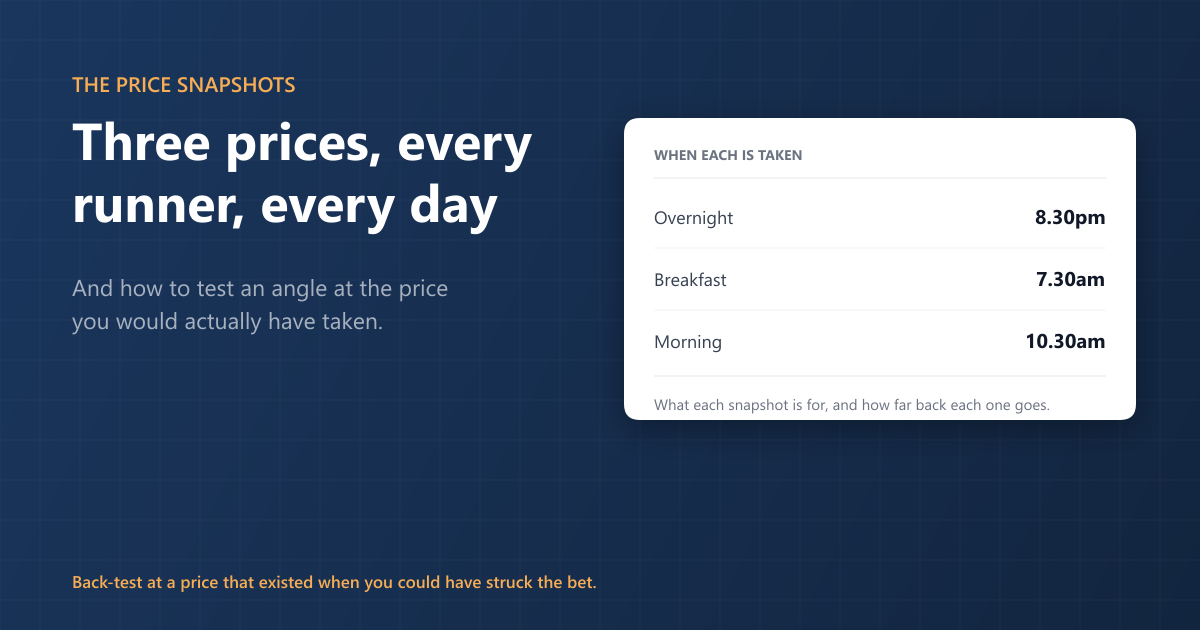
For every runner in every race, three bookmaker prices are recorded:
- Overnight — 8.30pm the night before racing
- Breakfast — 7.30am on the day
- Morning — 10.30am on the day
The prices are BoyleSports. For the earlier part of the history they were bet365 — the same snapshots at the same times, with a change of firm along the way.
Once the race has been run, four more prices join them: the industry SP, the Betfair win SP, the Betfair place SP, and the Betfair in-running low and high. So the record covers the whole price journey, from the night before through to the off and beyond it.
How far back, and how complete
Every price is stored against the individual horse in the individual race, and kept permanently. The desktop database holds them from March 2016, and the RaceMetrics database from 2018. Coverage is effectively every runner.
That permanence is the point. A price snapshot is only useful if it was taken before you needed it and never revised afterwards.
Why three, rather than one
Because they disagree, and the disagreement is the information.
Take a horse whose last three runs were priced 4.5 the night before, 4.5 at breakfast, 5.0 by mid-morning, and returned 7.2 on the exchange. Nothing about the horse changed between 8.30pm and the off. What changed was the market's read of it, and by the time the race was run the exchange price was more than half as big again as the overnight one.
Test that angle to SP and you measure a price you could not have taken. Test it to the 8.30pm snapshot and you measure the price that was actually in front of you.
What you can do with them
In the System Builder each snapshot is a filter in its own right — overnight price between 4.0 and 8.0, for instance. Beyond that:
- Price rank within the race at each of the three points: the overnight favourite, the second-shortest at breakfast, and so on.
- Percentage move between any two points — overnight to breakfast, breakfast to morning, morning to SP, and against Betfair SP. This is how you isolate steamers and drifters.
- Price against the Power Rating, as a value ratio, so you can screen for horses trading above their rated price the night before.
Back-test results come back at SP, at Betfair SP, and at the bookmaker prices themselves including best odds guaranteed. The three prices and their moves can also be added as columns on your racecard view, so the drift is visible on the card.
One thing that catches people out
A saved system with a price rule in it will list qualifiers before the relevant snapshot has arrived.
That is deliberate. Until 8.30pm there is no overnight price to test, so the list shows the runners that qualify on every other rule — the potential qualifiers. When the prices land, the ones that fail the price rule drop out. The same applies at breakfast and at 10.30am.
It reads as a fault if you are expecting an empty list until the prices arrive. It is not: it is the list telling you which runners are still in play on everything except the price.
Where to start
If you have never used them, the most direct route in is to take an angle you already trust and re-run it against the overnight price rather than SP. The strike rate will not move. The profit and loss usually will.