A speed rating is a number for how fast a horse actually ran, adjusted so that runs at different courses, over different trips and on different ground can be set side by side. Proform calculates one for every runner in every race as the results are compiled each day.
There are two families of them, and the difference between the two catches more people out than anything else in the form book: dynamic ratings change when you change a filter. Static ratings never move.
Dynamic ratings move with what you are looking at
Dynamic ratings are calculated from whichever runs are currently on screen. Filter the form to soft ground and the dynamic ratings redraw using soft-ground runs only. Filter to wins and every dynamic rating is suddenly built from winning form — which will, of course, look tremendous.
That is not a bug. It is the point: it lets you ask "what does this horse's speed profile look like under today's conditions". But it does mean a dynamic rating is only meaningful if you know what is filtered at the time you read it.
The ones you will see on the card:
- dyHA — the highest speed rating of the horse's career
- dy2HA — its second highest
- dyAVG — the average across all its runs
- dyMR — the median across all its runs
- dyLTO — the rating from its most recent outing
- dyAVG(x) and dyMR(x) — the average and median over the last x runs, where x is yours to set in preferences and defaults to 3
The median ones are worth more attention than they usually get. A career-best figure tells you what a horse did on its very best day, which may have been two years ago in different conditions. The median tells you what it typically does, and typical is what most races are won by.
Static ratings hold still — which is why they can be tested
Static ratings are fixed. They are also ranked within each race, so every runner has a position as well as a figure, and because they do not move they can be used as conditions in the System Builder. If you want to ask "do horses whose median figure over their last three runs beats the class par win more often than the market expects?", it has to be a static rating.
Two rules govern all of them, and both matter:
- Zero ratings are ignored. A horse that fell, was pulled up, or finished so far back that no figure was warranted does not drag its own average down. The run simply is not counted.
- Only the same race type counts. If today is a chase, the static ratings are built from that horse's chase figures. There are five types — Flat Turf, Flat All-Weather, Chase, Hurdle and National Hunt Flat — and they never mix.
The fields follow a simple grammar. stHA C is the highest achieved in the career, stHA L1y the highest in the last year, stMR C the career median, stMR L1y the median over the last year, stMR L3r the median over the last three runs. Once you can read HA as "highest achieved", MR as "median rating", C as career, L1y as last year and L3r as last three runs, the whole set explains itself.
A figure means nothing without the par
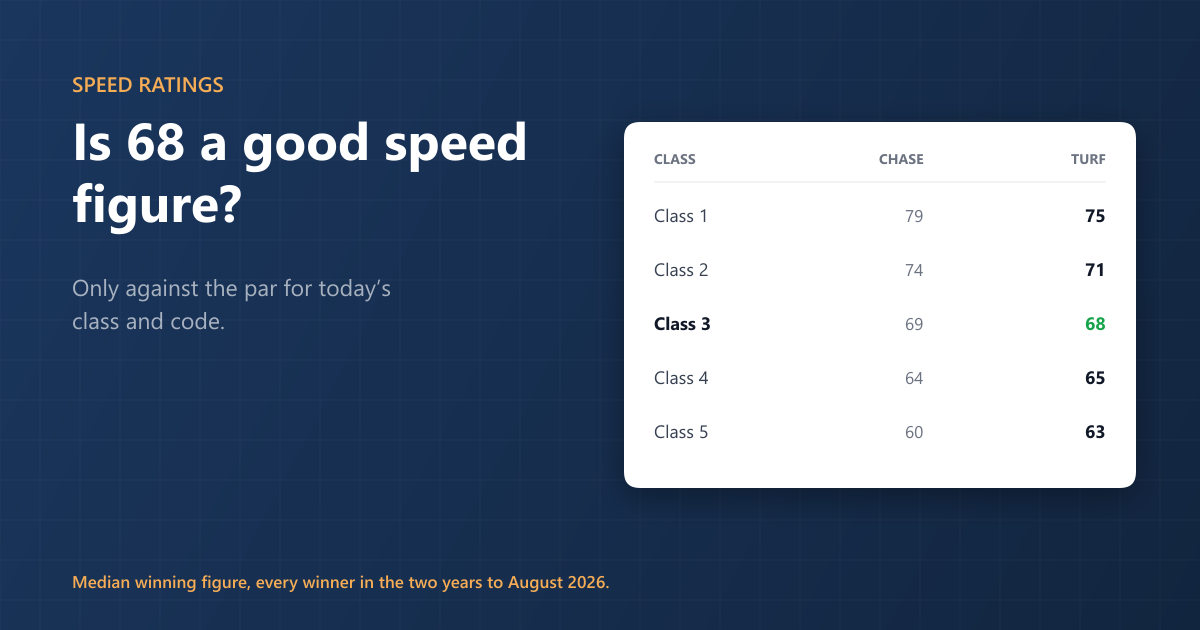
Is 68 a good speed rating? Unanswerable on its own. It depends entirely on the class of race and the type of racing.
That is what class pars are for: the median figure recorded by winners of each class, in each of the five race types. Clear the par and the horse has run to the standard that typically wins at that level. Fall short and it has not — yet.
Here is the current table, taken from every winner in Britain and Ireland over the two years to the end of August 2026:
| Class | Turf | A/W | Chase | Hurdle | NHF |
|---|---|---|---|---|---|
| 1 | 75 | 76 | 79 | 78 | 75 |
| 2 | 71 | 71 | 74 | 73 | 67 |
| 3 | 68 | 68 | 69 | 68 | — |
| 4 | 65 | 65 | 64 | 62 | 58 |
| 5 | 63 | 62 | 60 | 59 | 59 |
| 6 | 61 | 62 | — | — | — |
Dashes are where there were too few winners in the period to give an honest median — one chase and seven National Hunt Flat races respectively. We would rather show a gap than a number built on seven runs, which is the same standard we would ask of any statistic you build yourself.
Two things stand out. Jumps racing sets a higher bar at the top and a lower one at the bottom — a Class 1 chase winner records 79 where a Class 5 records 60, a wider spread than the Flat. And the pars have barely shifted: the figure of 76 for Class 1 all-weather is exactly what we published from data going back to 2006. A par is a slow-moving thing, which is what makes it useful as a yardstick.
Using them without fooling yourself
- Check what is filtered before reading a dynamic rating. If you have narrowed the form, the dynamic figures have narrowed with it.
- Prefer a median to a best. One outstanding afternoon does not repeat on demand.
- Compare against the par for today's class and code, not against the other horses' figures alone.
- Remember the race-type rule. A useful hurdle figure says nothing about a first run over fences.
- If you want to test an idea rather than eyeball it, you need a static rating — dynamic ones cannot be back-tested, because they depend on what was on screen at the time.
A speed figure is evidence of what a horse has done, not a forecast of what it will do. Set against the par for the grade it is running in today, it is one of the quickest ways to see whether a horse is up to the class it finds itself in.