A positive or a negative on a Proform racecard is a named statistical record with its sample attached. Not an opinion, not a rating, and not a tip. Each one says "here is a pattern this runner belongs to, here is how that pattern has performed, here is how many times it has been tried". What you do with it is entirely yours.
They are among the most-used things on the card and among the least explained, so here is what is actually behind them.
What is inside one
Every indicator carries its own working. A negative looks like this:
Trainer Form at Course and Distance (around 1m 7f 156y), 3-70 (4.29%), P&L £-24.62, Exp: 5.2, A/E: 0.6, Chi: 0.99
Read left to right, that is: the pattern being measured, the exact conditions, three winners from seventy runners, a strike rate of 4.29%, a loss of £24.62 to £1 level stakes, 5.2 winners expected from those seventy rides on market prices, an A/E of 0.6, and a chi-squared figure showing how unlikely the shortfall is to be chance.
The two numbers that matter most are the ones people skip. The sample tells you whether there is anything there at all. A/E — actual winners divided by expected winners — tells you whether the pattern did better or worse than the market thought it would. Above 1.00 is outperforming the market; below is underperforming. A strike rate on its own tells you almost nothing, because a 4% strike rate at big prices can be far better than a 20% strike rate at short ones.
Do not count them
The commonest mistake is treating the indicators as a score — four positives beats two positives, and a negative cancels a positive out. They do not work like that, and the numbers show why.
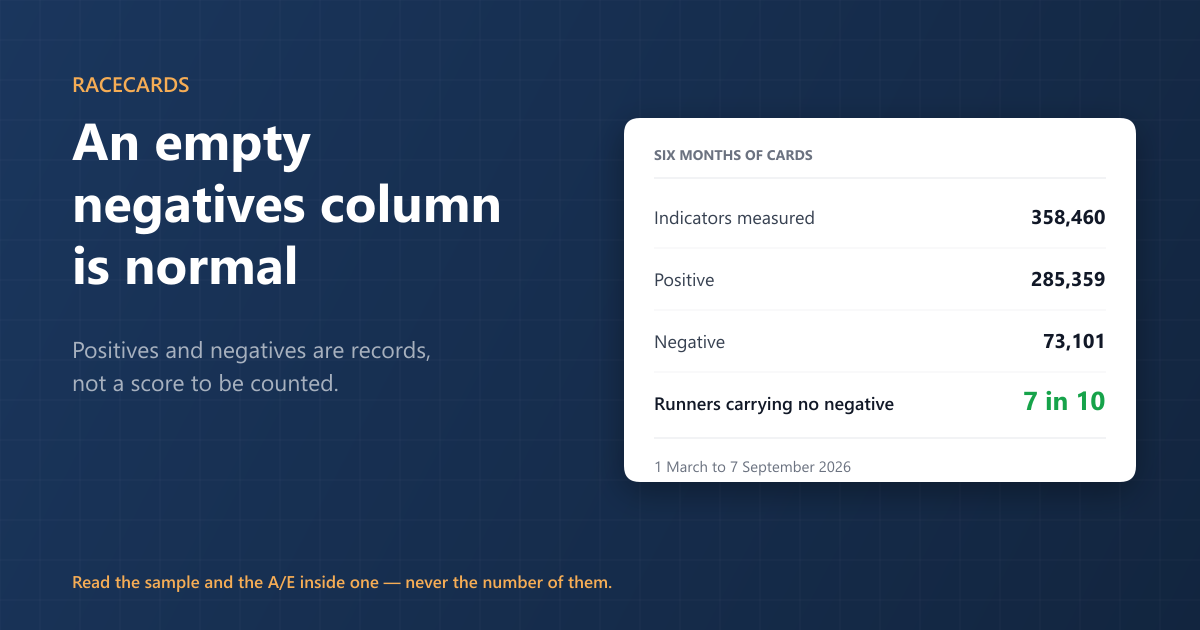
Across the six months to the start of September, our cards carried 358,460 indicators over 208,902 runners. Of those, 285,359 were positive and 73,101 negative — very nearly four positives for every negative. The average runner carrying anything at all carries 1.4 positives and 0.35 negatives.
Which leads to the number worth remembering: seven runners in every ten carry no negative whatsoever. An empty negatives column is not a green light. It is the normal state of a racehorse. Meanwhile 15% of runners carry no positive, and the busiest single runner in the period carried nine.
So a horse with three positives and no negatives is not "better" than one with one positive. It is a horse that happens to sit inside three measured patterns. Whether any of them is worth a penny depends entirely on what is inside them.
Most of them are not about the horse
Here is the thing that surprises people. The five biggest sources of positives are:
- Trainer form at today's course and distance — 63,132
- Jockey form at today's course and distance — 53,926
- Sire form at today's course and distance — 42,464
- Trainer and jockey together at today's course — 27,768
- The horse's own course-and-distance form — 12,560
Only about one positive in twenty-three is about the animal in the race. The rest describe the people around it and the stallion that bred it. That is not a flaw — connections and pedigree records are exactly the sort of thing a human cannot hold in their head across every meeting — but it does change how you should read them. A card full of positives is usually telling you something about a yard's record at that track, not that the horse is well handicapped.
The rest come from more specific angles: horses returning from a break, trainers with last-time-out winners, first-time headgear records, stable switches, a trainer's record with two-year-old debutants, first run in a handicap, and horses that have been running below halfway in the field in running.
How to read one properly
- Look at the sample before anything else. "0-3" is three runs. It is not evidence of anything, in either direction.
- Then look at A/E, not the strike rate. It is the one that accounts for price.
- Check what is actually being measured. A trainer statistic is a fact about the trainer. It becomes a fact about the horse only if you decide it does.
- Treat a lone negative on a strong runner with care. Given that most runners carry none at all, a negative is worth reading properly rather than reacting to.
What they are not
They are not selections, they do not rank the field, and they are not adjusted for each other — two positives drawn from the same trainer's record are not two independent pieces of evidence. They are a way of putting the relevant history in front of you in the ten seconds you have before the next race, so that you are arguing with numbers instead of remembering them.
If you want the runners picked out for you rather than described, that is the Bet Finder, and several of these same patterns exist there as angles you can filter on.