
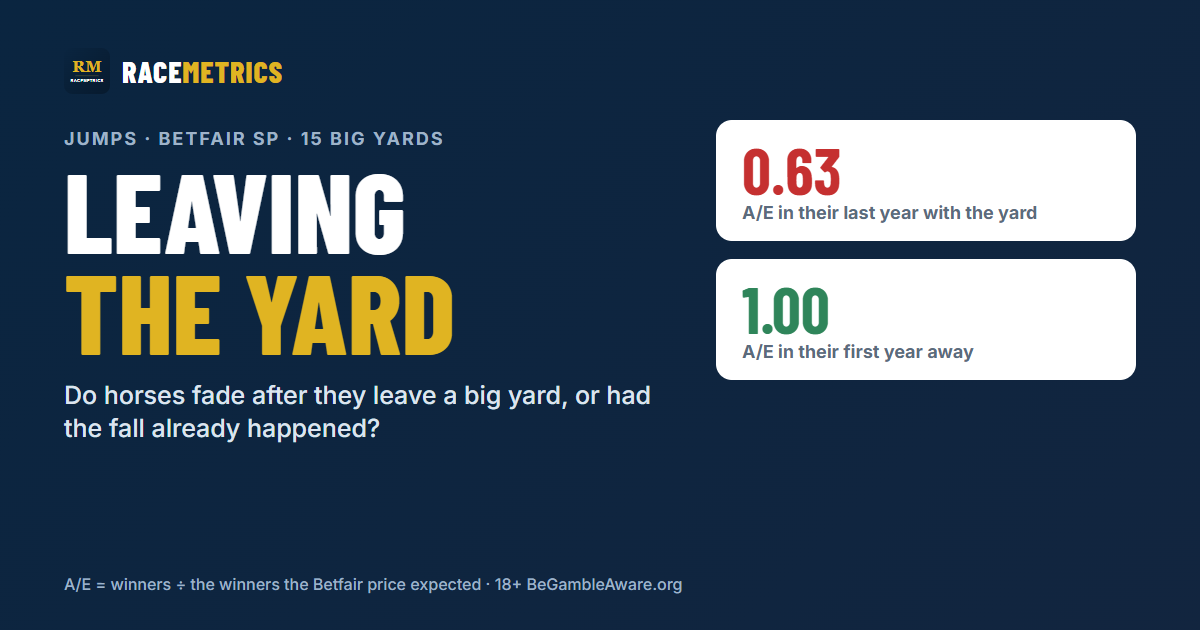
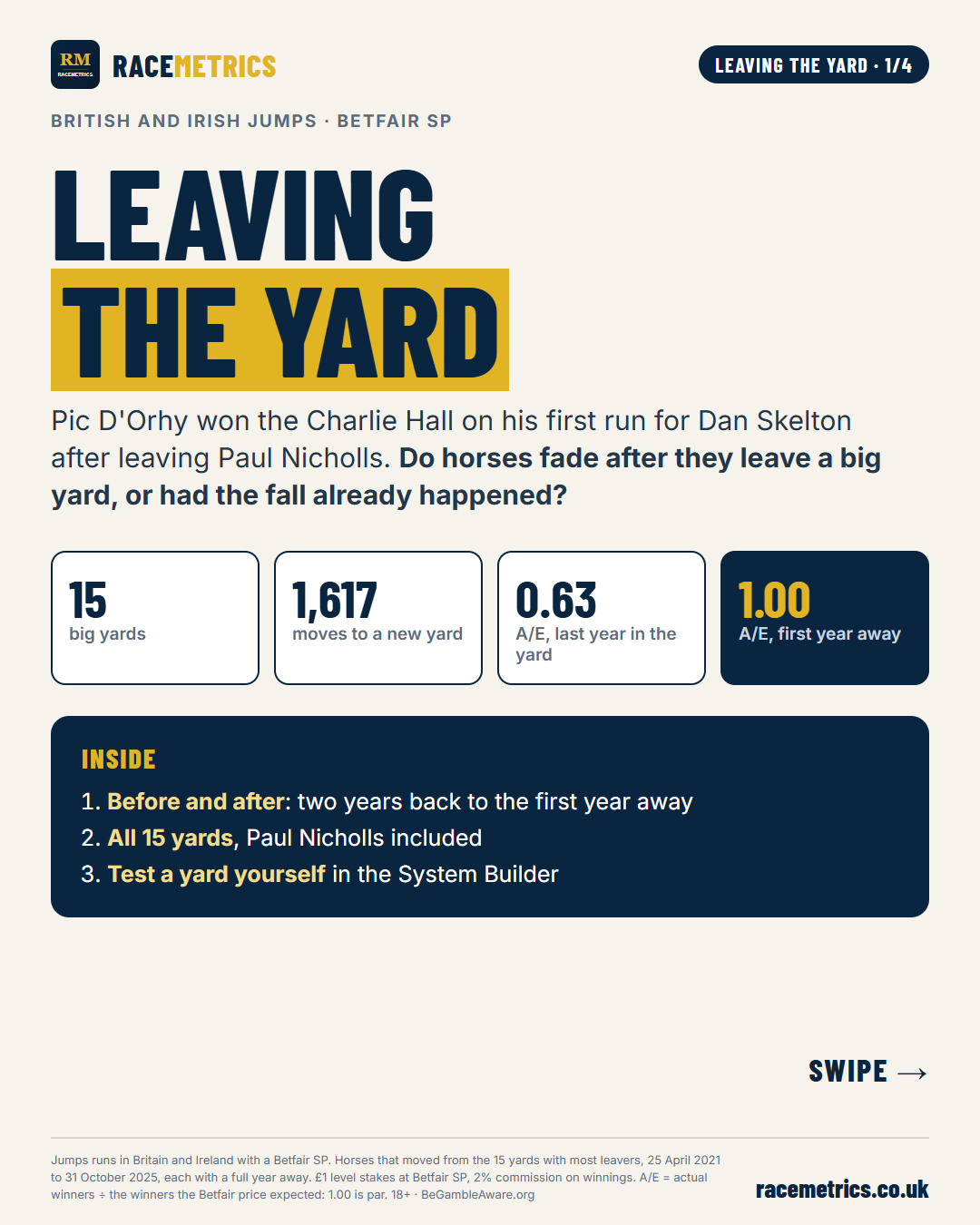
Pic D'Orhy won the Charlie Hall on his first run for Dan Skelton after leaving Paul Nicholls, and that raises an old question. When a horse leaves a big jumps yard, does it fade? We followed 1,617 moves from the 15 yards with most leavers and compared each horse's last year in the old yard with its first year away, at Betfair SP.
THE SHORT VERSION
- The fall comes before the move. In their last year with the old yard these horses had an A/E of 0.63 at Betfair SP. The rest of the same 15 yards ran at 1.03.
- After the move they win what their prices say. First year away: A/E 1.00 from 7,668 runs. No fade, and no bonus: level stakes still lost 888 points.
- It happens at almost every yard. All 15 yards' leavers ran below the rest of their yard in their last year, and 14 of the 15 had a better A/E once they had gone.
- Paul Nicholls fits the pattern. Leavers 0.58 in their last year, 1.05 in their first year away, and the rest of his yard 1.06.
- You could not have bet the 0.63. Nobody knows in advance which horses will leave, and horses that disappoint are more likely to be sold.
Before and after
A/E is the number of winners a group had, divided by the number the Betfair price expected. 1.00 means the price was right. Win % alone cannot answer this question, because a horse that is slipping usually starts at a bigger price, so it should win less often anyway. A/E takes that into account.
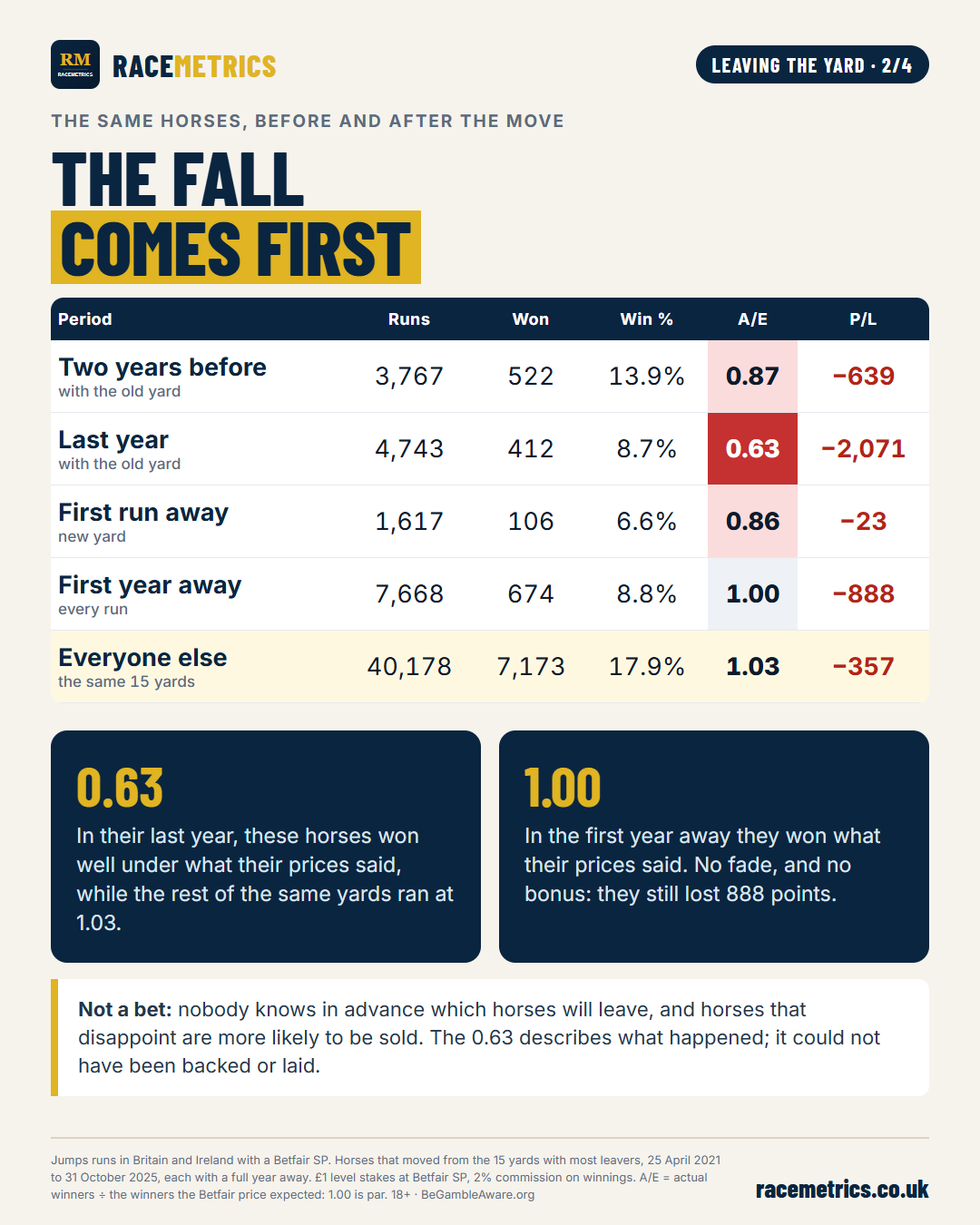
- Two years before the move: 522 winners from 3,767 runs, 13.9%, A/E 0.87. Already below par.
- The last year with the old yard: 412 from 4,743, 8.7%, A/E 0.63, a loss of 2,071 points at Betfair SP.
- The first year away: 674 from 7,668, 8.8%, A/E 1.00, a loss of 888 points.
- Everyone else at the same yards: 7,173 from 40,178, 17.9%, A/E 1.03.
The win rate hardly moves after the change of yard. What changes is the price: by the first year away, the market has caught up with the horse.
A/E 1.00 alongside a loss of 888 points is not a mistake. It means the group won as many races as its prices implied, but more of those wins came at the shorter prices, and 2% commission comes off every winner too.
Why you cannot bet the 0.63
This is the most striking figure here and the least useful. We only know these horses left because we are looking back. A horse that keeps winning tends to stay, and one that keeps disappointing is more likely to be sold, so picking out the leavers afterwards picks out many of the yard's disappointing horses. It describes what happened. It could not have been backed or laid at the time.
Is a first run for a new yard a good bet?
Not on these figures. First runs away produced 106 winners from 1,617, 6.6%, with an A/E of 0.86. That is below par, though with a difference this size chance could be part of it. The level-stakes loss was only 23 points, because a few long-priced winners did a lot of the work, so it would be unwise to lean hard on either number.
All 15 yards
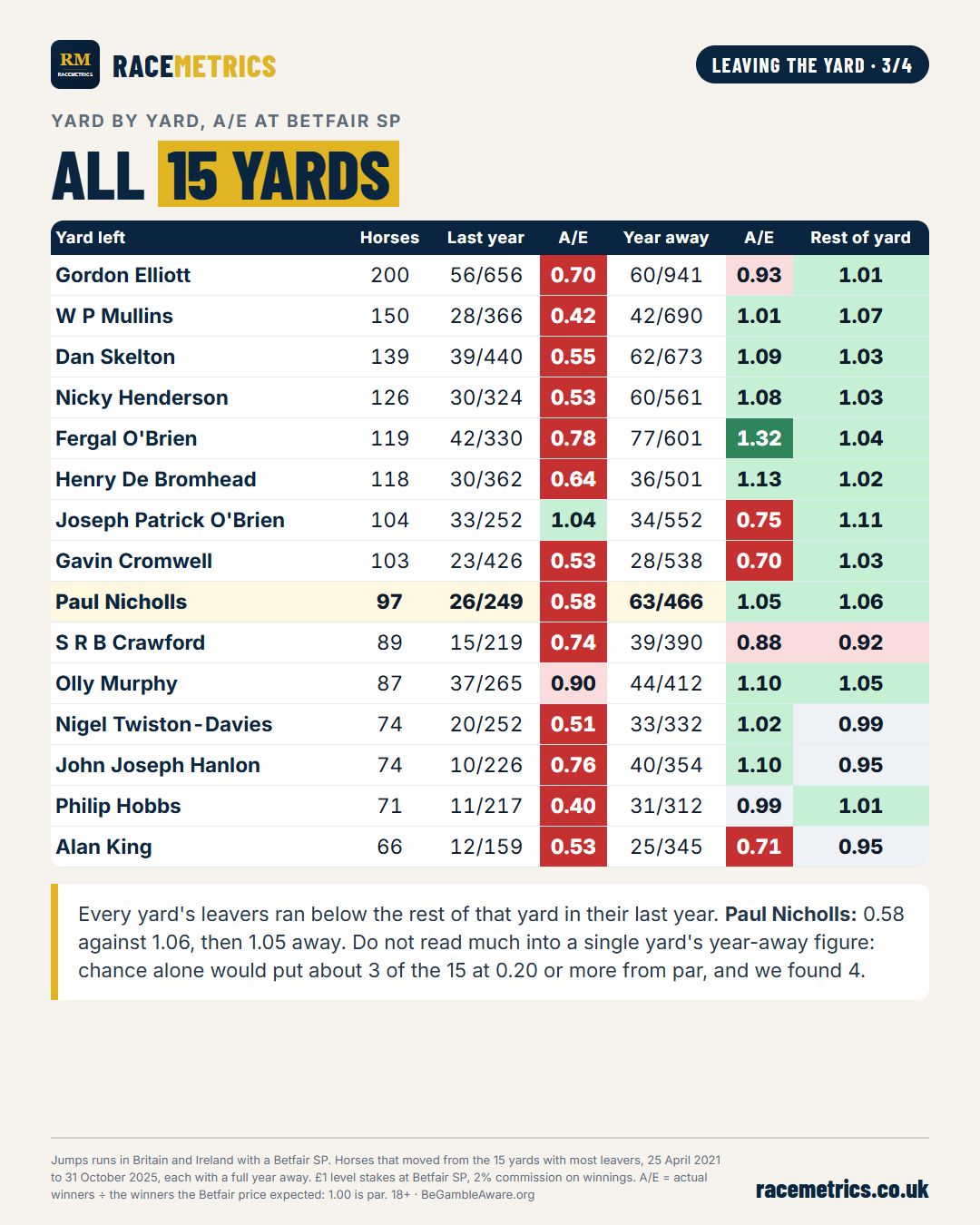
Every yard's leavers ran below the rest of that yard in their last year. Joseph Patrick O'Brien's are the one exception to the rise afterwards: 1.04 in their last year, 0.75 away.
The year-away column is tempting to read as a league table of whose cast-offs to follow. Be careful. Fergal O'Brien's leavers lead it at 1.32 and 77 winners, with Gavin Cromwell's and Alan King's at the bottom on 0.70 and 0.71. But chance alone would put about 3 of the 15 yards at 0.20 or more from par, and we found 4. These figures do not separate one yard's leavers from another's.
Paul Nicholls' leavers went to many trainers, with Harry Derham taking the most: 14 horses, 12 winners from 61 runs in their first year with him, A/E 1.11. That is too few runs to say more than it looks encouraging.
What it means when you read a card
- Do not mark a horse down just because it has left a big yard. As a group, the fade you might expect is not there.
- Do not mark it up for the change either. The market prices the move about right over a year, and the first run shows no bonus.
- A poor last year in the old yard says less about the yard than about which horses get sold. The rest of those yards were doing fine.
Test a yard yourself

In the System Builder (RaceMetrics Pro and Proform Premium), set Race Type to Chase, Hurdle and NHF. Add First Run for New Trainer and set it to Yes, then add LTO Trainer and choose the yard the horse has just left. Read A/E and P/L at Betfair SP, then open the Trainer breakdown to see who took them on. The System Builder's history starts in 2018.
How we measured it
- A move: a horse's first jumps run for a new trainer after a run for its old one, between 25 April 2021 and 31 October 2025, so every horse has a full year away. Trainers are as named on the racecard.
- Yards: the 15 trainers with 60 or more horses leaving in that time, across Britain and Ireland.
- Left out: five cases where a string of 25 or more horses passed between one pair of trainers, such as Colin Tizzard to Joe Tizzard, because the horses did not really change stables in the usual sense. Those five took 321 moves out.
- Runs: chase, hurdle and bumper runs with a Betfair SP, finished or not, non-runners excluded. "Last year" and "two years before" count runs for the old yard in the 365 days before the move and the 365 before that. "First year away" counts all runs in the 365 days after it, for any trainer except the old one.
- Everyone else: all other runs for the same 15 yards from 25 April 2020 to 31 October 2025, including those horses' runs outside their last year.
- Prices: £1 level stakes at Betfair SP, 2% commission on winnings. A/E = actual winners ÷ the sum of 1/(Betfair SP + 1) over the runners.
- Chance: the "chance alone" figure comes from simulating each yard's first year away 4,000 times, with its expected winners set by the Betfair price.
Past figures describe what happened; they are a lens on the market, not a promise of profit. 18+ BeGambleAware.org